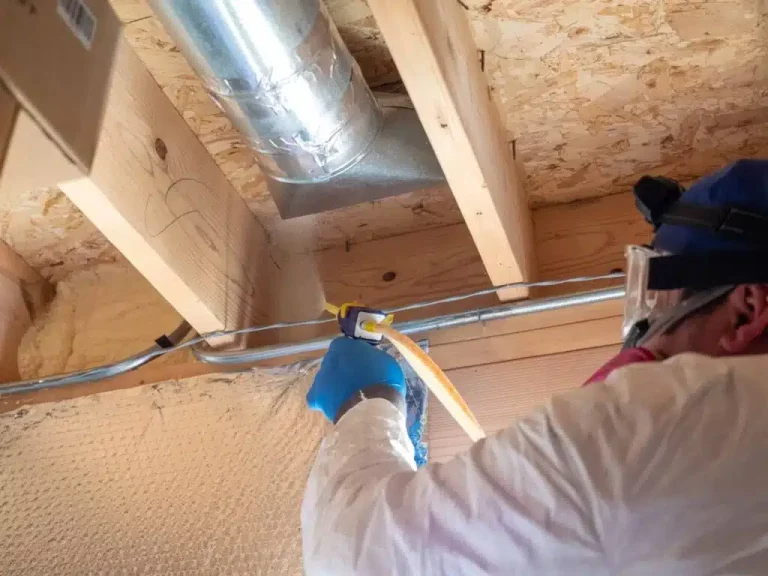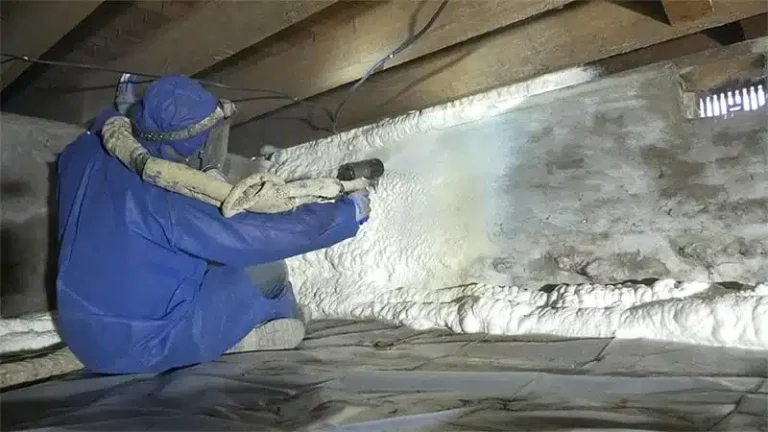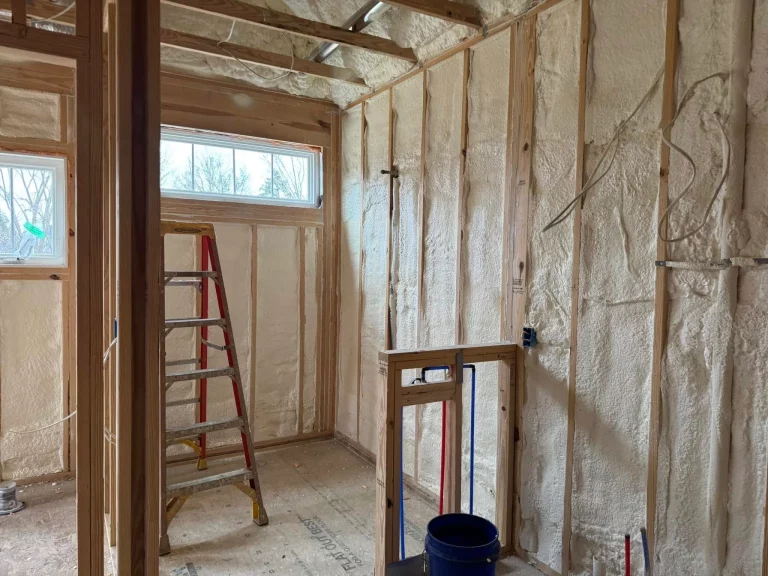

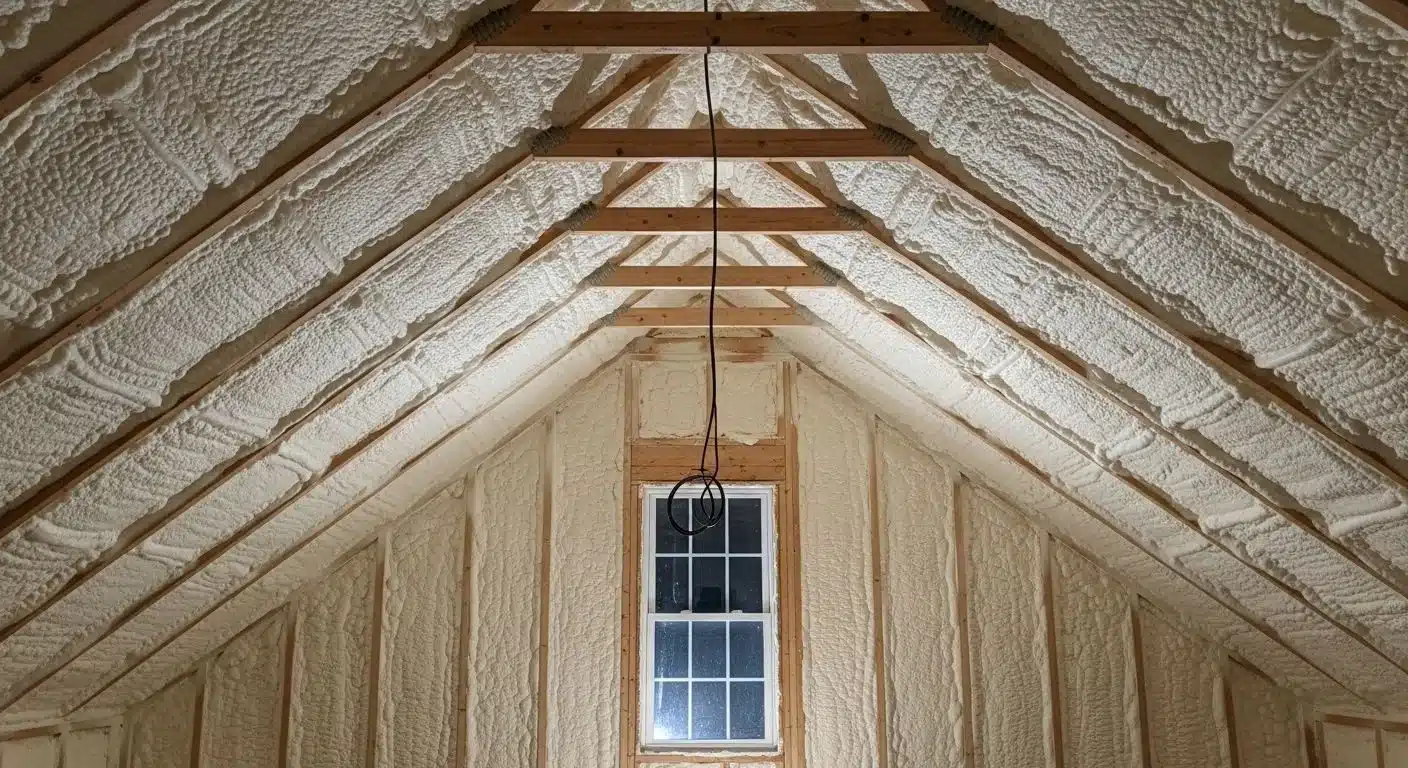
Attic spray foam insulation delivers a combination of air sealing and thermal resistance that mineral wool simply cannot match when temperatures drop. While mineral wool is a strong performer in its own right, it is a fibrous batt insulation that relies on friction-fit installation and separate air sealing steps to prevent drafts. Spray foam, by contrast, expands on application to fill gaps, cracks, and penetrations at the ceiling plane, creating a continuous air barrier and insulating layer in a single step. In cold climates, where heat loss through the attic can account for a substantial portion of a building’s total energy waste, that built-in air sealing makes a meaningful difference in both comfort and heating costs.
The Department of Energy notes that in winter, heat flows directly from heated living spaces to unheated attics and the outdoors, and the R-value of insulation (its resistance to heat flow) directly determines how effectively that transfer is slowed DOE Energy Saver – Insulation. For homeowners and contractors operating in cold climate zones, spray foam also offers moisture resistance, structural rigidity, and the ability to convert a vented attic into a sealed, conditioned space, which eliminates ice dam risk entirely.
TL;DR
- Spray foam insulation provides both thermal resistance and air sealing in a single application, while mineral wool requires a separate air sealing step before installation.
- Closed-cell spray foam delivers R6.0 to R7.0 per inch, roughly double the R-value per inch of mineral wool, allowing it to meet high R-value requirements in thin attic spaces.
- In cold climate zones (4 through 8), ENERGY STAR recommends R49 to R60 for uninsulated attics, which spray foam can achieve with less material thickness.
- EPA estimates average savings of 15% on heating and cooling costs through proper air sealing and insulation, with northern climate zones seeing total house savings of 12 to 16% ENERGY STAR – Methodology for Estimated Energy Savings.
- Spray foam adheres directly to rafters, joists, and irregular surfaces, sealing penetrations that mineral wool batts cannot cover.
- Mineral wool is naturally non-combustible and offers superior sound absorption (NRC of 1.0), making it better suited for fire-rated wall assemblies and interior sound control.
- Moisture resistance is a major advantage for spray foam in cold climates, where condensation and ice dams pose recurring threats to building envelopes.
How Each Material Performs in Cold Attics
Thermal Resistance and R-Value Density
R-value is the standard measure of how well insulation resists heat flow, and the higher the number, the better the thermal performance ENERGY STAR – Recommended Home Insulation R-Values. For cold climate zones, the stakes are high. Uninsulated attics in zones 5 through 8 should target R60, and even attics with existing insulation should reach R49.
Mineral wool batts and blankets typically deliver between R3.3 and R4.2 per inch. To reach R49 with mineral wool alone, you would need roughly 12 to 15 inches of material. In many older homes, the attic cavity between the ceiling joists and the roof deck simply does not have that much clearance, especially at the eaves where low-slope roofs create tight spaces.
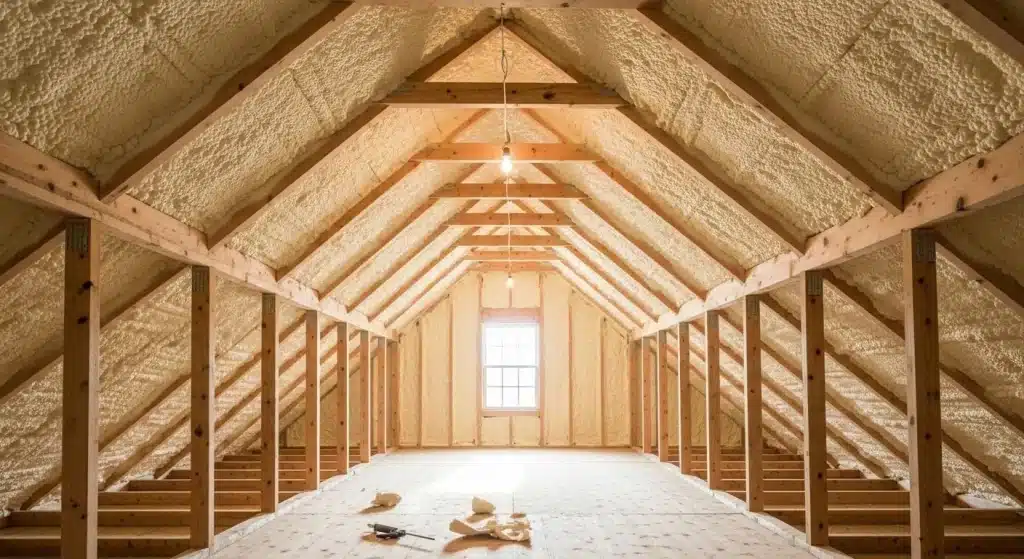
Spray foam solves this problem through higher R-value per inch. Open-cell spray foam provides approximately R3.5 to R3.8 per inch, comparable to mineral wool on a per-inch basis. Closed-cell spray foam, the product most commonly recommended for cold climate attics, delivers R6.0 to R7.0 per inch. That means a 7-inch application of closed-cell foam can achieve R49 or better, fitting within attic cavities where mineral wool would overflow or compress against the roof deck.
Air Sealing: The Deciding Factor in Cold Weather
The performance gap between these two materials widens considerably when you factor in air movement. According to the DOE, insulation effectiveness depends not only on R-value but also on how and where it is installed, and insulation that fills cavities reduces airflow and saves energy. Air leakage through the attic floor (around recessed lights, plumbing vents, electrical wiring, and the doorway-to-top-plate gap) is one of the primary drivers of heat loss in cold weather.
Mineral wool batts are friction-fit between framing members. Even with careful installation, small gaps remain around pipes, wires, and irregular framing. These gaps allow warm indoor air to escape into the attic, where it meets cold surfaces and creates condensation. The Insulation Institute notes that fiberglass, mineral wool, and cellulose all require separate air sealing to work properly, while spray foam provides some air sealing when applied correctly Insulation Institute – Comparing Insulation Types.
Spray foam, especially closed-cell, expands into every crack and crevice on the attic floor. When applied as an air barrier layer, it seals top-plate gaps, penetrations, and transitions between different framing materials in a continuous application. The Building America Solution Center at PNNL specifically recommends a minimum 1-inch layer of closed-cell spray foam on the attic floor to create a continuous air control layer, followed by additional insulation to meet code R-values PNNL Building America Solution Center – Spray Foam Applied to Existing Attic Floor.
Moisture Control and Ice Dam Prevention
Cold climates create a specific moisture problem: warm indoor air leaks into the attic, condenses on the cold roof deck, and can saturate insulation or promote mold growth. In snowy regions, that same heat leakage melts snow on the roof surface, which refreezes at the eaves to form ice dams.
Mineral wool is vapor-permeable. It allows moisture to pass through, which can be either an advantage or a disadvantage depending on the assembly. In a vented attic with proper vapor retarders, mineral wool can dry effectively. But if warm, moist air is leaking past the batts and condensing on cold surfaces, the permeability of the insulation will not stop the problem.
Closed-cell spray foam acts as both an air barrier and a vapor retarder. Two inches of closed-cell spray foam functions as a Class II vapor retarder, blocking the passage of water vapor through the ceiling plane. In cold climate zones, the PNNL guide notes that this approach eliminates the pathway for interior moisture to reach the roof deck and significantly reduces ice dam formation by preventing heat from escaping through ceiling penetrations. This is also why many homeowners look into attic spray foam labor when understanding installation factors.
Head-to-Head Comparison
| Factor | Attic Spray Foam (Closed-Cell) | Mineral Wool Batts |
|---|---|---|
| R-value per inch | R6.0 to R7.0 | R3.3 to R4.2 |
| Air sealing capability | Built-in, expands into gaps and cracks | Requires separate air sealing step |
| Moisture resistance | Acts as vapor retarder (Class II at 2 inches) | Vapor-permeable, allows moisture passage |
| Fire resistance | Ignites at 700 degrees F, requires thermal barrier | Naturally non-combustible, withstands over 1,000 degrees C |
| Sound absorption | NRC 0.75, STC 37-39 | NRC 1.0, STC 43 |
| Installation method | Sprayed on-site by trained professionals | Friction-fit batts, can be DIY |
| Thickness needed for R49 | Approximately 7 to 8 inches | Approximately 12 to 15 inches |
| Adhesion to surfaces | Bonds to wood, metal, concrete, and most substrates | Relies on friction fit between framing |
Real-World Scenarios
| Scenario | Property Type | Recommended Option | Rationale |
|---|---|---|---|
| 1970s ranch home with chronic ice dams and 4 inches of existing blown fiberglass | Single-family residence, climate zone 5 | Closed-cell spray foam over attic floor | Air sealing eliminates the heat leakage causing ice dams; higher R-value per inch fits within shallow eave cavities |
| New construction with raised-heel trusses and target of R60 | Custom build, climate zone 6 | Spray foam air barrier layer plus blown-in insulation over top | Spray foam creates the continuous air control layer; cost-effective blown insulation fills to full R60 depth |
| Commercial warehouse with metal roof deck and minimal attic clearance | Light industrial building, climate zone 4 | Closed-cell spray foam directly to roof deck | Thin application achieves required R-value; adhesion to metal substrate eliminates need for mechanical fasteners |
| Historic home preservation project requiring fire-rated assembly | Pre-1940 residential, climate zone 5 | Mineral wool in wall cavities, spray foam at attic floor | Mineral wool provides non-combustible fire protection in walls; spray foam handles the attic air sealing that mineral wool cannot |
| Basement-to-attic whole-home energy retrofit | Two-story home, climate zone 7 | Closed-cell spray foam at attic floor and rim joist | Highest R-value per inch addresses both locations where cold climate heat loss is most severe |
Factors That Influence the Decision
Several variables determine which material performs best in a given attic project:
- Climate zone: Colder zones (5 through 8) demand higher R-values and place greater importance on air sealing and moisture control, tilting the advantage toward spray foam
- Attic geometry: Low-pitch roofs and shallow eave cavities make it difficult to achieve code-required R-values with mineral wool without exceeding the available space
- Existing conditions: Attics with extensive air leakage, multiple penetrations, or ductwork running through the space benefit most from spray foam’s ability to seal and insulate simultaneously
- Ventilation strategy: Vented attics can use either material with proper air sealing, but unvented (sealed) attic assemblies typically require spray foam applied to the roof deck
- Fire code requirements: Buildings that require non-combustible insulation in specific assemblies may need mineral wool in those locations, even if spray foam is used in the attic
- Budget and project scope: Mineral wool is less expensive per square foot for straightforward wall cavity fills, but the total installed cost comparison shifts when factoring in the separate air sealing labor required with batt insulation
Who Spray Foam Attic Insulation Is For
- Homes in cold climate zones (4 through 8) with inadequate attic insulation and visible air leakage
- Properties experiencing recurring ice dams caused by heat escaping through the ceiling plane
- Buildings with shallow attic cavities, low-pitch roofs, or cathedral ceilings where material thickness is limited
- Retrofit projects where the attic floor has numerous penetrations around plumbing stacks, electrical runs, and HVAC flues
- New construction targeting high-performance or net-zero energy standards where the building envelope must be as tight as possible
Who Spray Foam Attic Insulation Is NOT For
- Projects requiring a non-combustible insulation material for code compliance or fire-rated assemblies (mineral wool is the better choice here)
- Homeowners looking for a DIY installation, since spray foam requires professional equipment, training, and safety protocols
- Interior wall and partition applications where sound isolation is the primary objective (mineral wool’s higher NRC rating makes it superior for acoustic performance)
- Structures where the insulation must remain fully vapor-open and drying-capable in both directions without any vapor retarder class
Request Your Attic Insulation Assessment
Supreme Spray Foam Fresno provides professional attic spray foam insulation services for residential and commercial properties throughout the Fresno area and surrounding Central Valley region. Our team evaluates each attic’s specific conditions, including air leakage pathways, existing insulation levels, and ventilation configuration, to recommend the right spray foam application and R-value target for your building. We handle everything from initial assessment through professional installation using industry-grade materials and equipment.
Call us at (559) 545-0800 or email [email protected] to get started. Our specialists are ready to help you stop heat loss, prevent ice dams, and improve comfort before the next cold season arrives.
Frequently Asked Questions
Can spray foam insulation be installed over existing mineral wool in the attic?
No. The existing mineral wool and any other insulation must be removed first to expose the clean attic floor surface. Spray foam requires direct adhesion to the substrate to create an effective air seal, and debris, dust, or old insulation underneath will compromise both adhesion and performance.
How does spray foam handle the risk of ice dams in cold climates?
Spray foam applied to the attic floor seals the air leaks that allow warm indoor air to reach the roof deck, which is the primary cause of snow melt and ice dam formation. By eliminating that heat escape path and providing a continuous air barrier at the ceiling plane, spray foam addresses the root cause rather than just the symptoms.
Is mineral wool ever the better choice for attic insulation?
Mineral wool is a strong option for vented attics with adequate cavity depth where separate air sealing has already been completed, and where its non-combustible nature is required by code. It also outperforms spray foam in sound isolation applications. However, for cold climate attics where air sealing, moisture control, and space limitations are priorities, spray foam delivers superior overall performance.
Does spray foam insulation require a thermal barrier in attic applications?
When spray foam is installed on the attic floor (the ceiling plane below the living space), it is generally covered by the existing drywall ceiling, which serves as the required thermal barrier. When spray foam is applied directly to the underside of the roof deck in an unvented attic assembly, an approved thermal barrier such as half-inch drywall must be installed over the foam surface to meet building code requirements.
What R-value should I target for my attic in a cold climate?
For climate zones 4 through 8, ENERGY STAR recommends R49 for attics that already have 3 to 4 inches of insulation and R60 for uninsulated attics. Closed-cell spray foam can achieve these targets with significantly less material thickness than mineral wool, making it the practical choice for attics with limited cavity depth.
Sources
- ENERGY STAR – Recommended Home Insulation R-Values – Climate zone-specific R-value recommendations for attics and other building assemblies based on the 2021 IECC.
- DOE Energy Saver – Insulation – Comprehensive overview of how insulation works, R-value fundamentals, heat flow mechanisms, and the relationship between proper installation and energy savings.
- PNNL Building America Solution Center – Spray Foam Applied to Existing Attic Floor – Detailed technical guidance on using spray foam as an air barrier and insulation layer on attic floors, including cold climate moisture and ice dam considerations.
- Insulation Institute – Comparing Insulation Types – Side-by-side comparison of fiberglass, mineral wool, cellulose, and spray foam covering air sealing, fire safety, acoustics, and installation quality control.
- ENERGY STAR – Methodology for Estimated Energy Savings – EPA’s energy modeling data showing estimated savings from air sealing and insulation by climate zone, with northern zones achieving 12 to 16% total house savings.

- What Makes Crawl Space Spray Foam a Choice for Better Air Quality in Oakhurst, CA? - September 22, 2026
- Crawl Space Spray Foam: Types, Benefits, Costs, Installation, and Guide - September 22, 2026
- How Long Should Spray Foam Insulation Last Before It Needs to Be Repaired in Ahwahnee, CA? - September 11, 2026