
Advanced spray foam insulation systems consistently outlast every other common insulation type in terms of maintaining installed performance over decades. While fiberglass batts and mineral wool can technically survive for 80 to 100 years in a wall cavity, their effective thermal performance degrades much sooner due to settling, moisture absorption, gaps from poor installation, and air movement through the material. Spray foam, on the other hand, adheres permanently to the substrate, creates a continuous air seal, resists moisture, and does not sag, settle, or shift over its service life. Closed-cell spray foam delivers an initial R-value of approximately R-7 to R-8 per inch, and while some thermal drift occurs in the first two years as the blowing agent gas exchanges with air, the foam then stabilizes and maintains that performance for the life of the building. Open-cell spray foam offers a lower R-value per inch but shares the same structural permanence and resistance to degradation. When you factor in how insulation actually performs in real-world conditions, not just the number printed on a label, spray foam delivers the longest useful lifespan by a wide margin.
TL;DR
- Spray foam insulation maintains its installed R-value and structural integrity for the life of the building when properly applied, with closed-cell foam stabilizing after a brief initial thermal drift period.
- Fiberglass batts can last 80 to 100 years as a material but may begin sagging and losing thermal effectiveness within 15 to 20 years in actual wall and attic installations.
- Cellulose insulation is the most vulnerable to degradation, with a typical effective service life of 20 to 30 years due to moisture sensitivity, settling, and pest susceptibility.
- Mineral wool resists moisture and fire well but can still settle or compress over time in certain applications, reducing its effective R-value.
- Closed-cell spray foam doubles as a vapor barrier and air seal, eliminating the air leakage paths that silently undermine the performance of all other insulation types.
- Thermal drift affects closed-cell foam products, with most R-value loss occurring within the first two years, after which performance remains stable according to DOE research.
- The R-value of most insulation materials also depends on temperature, aging, and moisture accumulation, making the air-sealing quality of spray foam a decisive long-term advantage.
How Each Insulation Type Ages Over Time
The concept of insulation “lifespan” has two layers: how long the physical material lasts, and how long it continues to perform at its rated R-value. These are very different things. A fiberglass batt sitting inside a wall for 80 years does not mean it has been performing effectively for 80 years.
Spray Foam Insulation
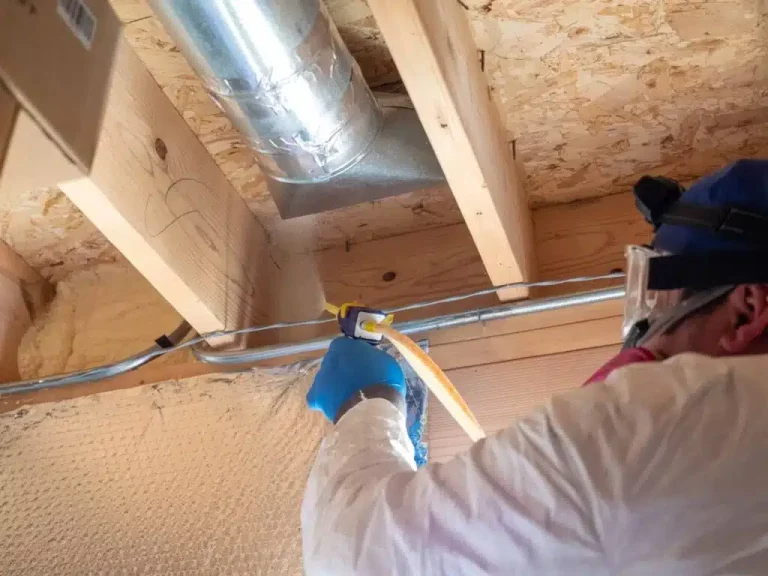
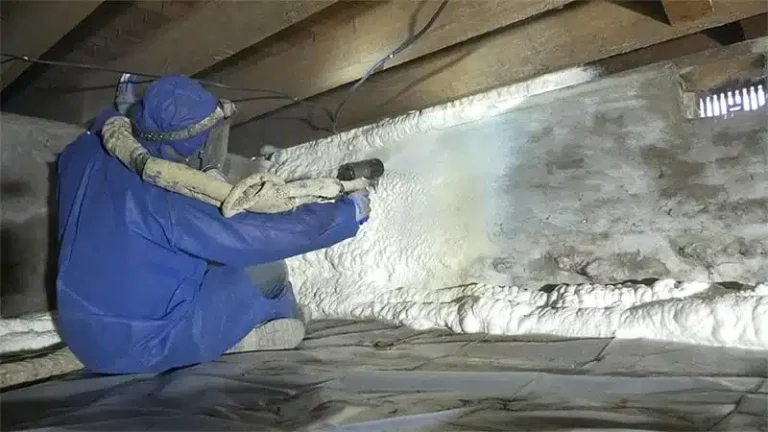
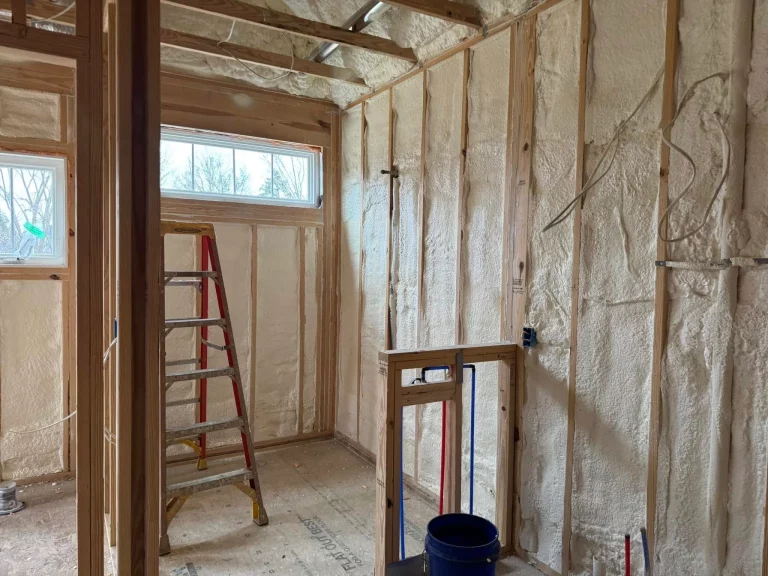
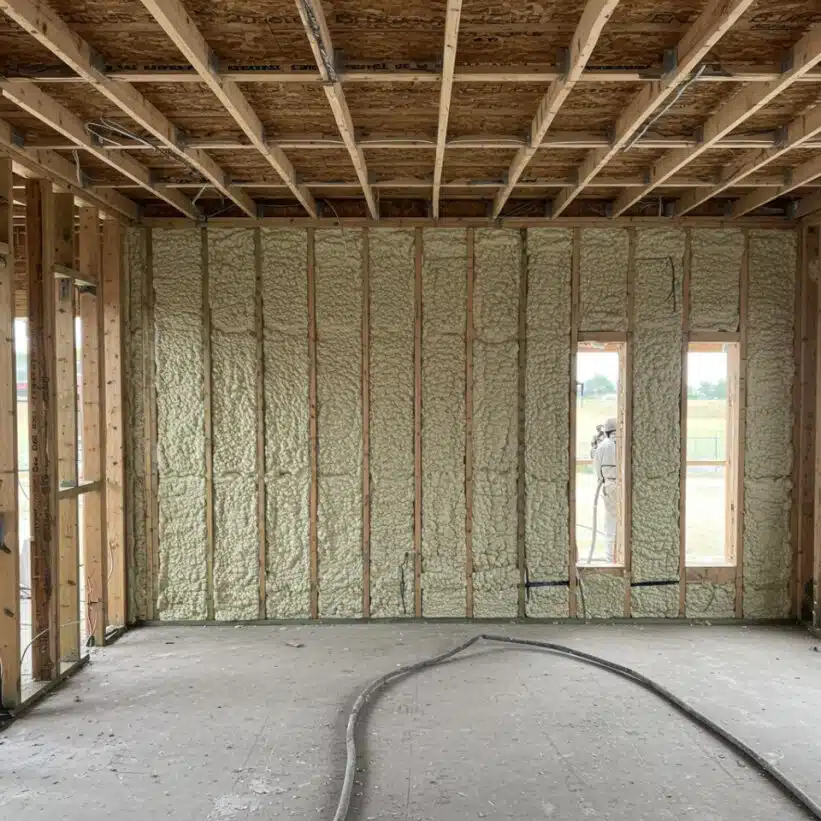
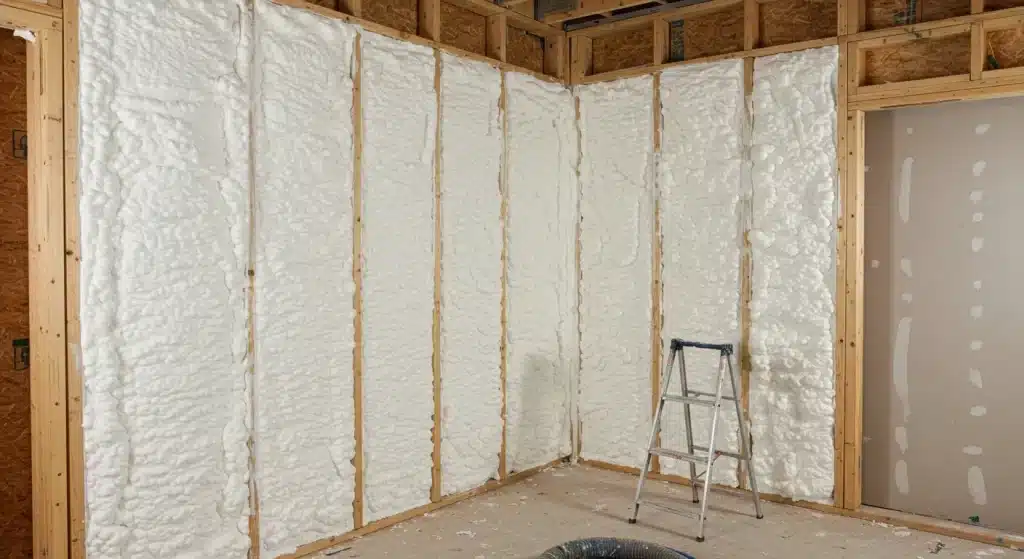
Spray foam is applied as a liquid that expands and cures into a solid, adhering directly to framing, sheathing, pipes, and wires. Once cured, it becomes a permanent part of the building envelope. It does not sag, settle, or shift because it is chemically bonded to every surface it touches. This is the fundamental reason spray foam outperforms other types over time, as explained in spray foam insulation guide.
According to the U.S. Department of Energy, liquid foam insulation materials can be sprayed, foamed-in-place, injected, or poured, and some installations yield a higher R-value than traditional batt insulation for the same thickness while filling even the smallest cavities to create an effective air barrier.
Closed-cell spray foam starts with an R-value of approximately R-7 to R-8 per inch, per InterNACHI. The gas trapped inside its closed cells provides superior thermal resistance at first. Over time, some of this low-conductivity gas escapes and is replaced with ordinary air, a process called thermal drift. DOE research cited by InterNACHI shows most thermal drift occurs within the first two years after installation, and then the foam remains relatively unchanged unless physically damaged. After that stabilization period, you are working with a known, stable R-value for the remainder of the building’s life.
Open-cell spray foam has a lower R-value per inch (approximately R-3.5 to R-3.7) and does not act as a vapor barrier, but it shares the same adhesion and permanence characteristics. It also fills cavities completely and seals against air leakage, which is where a large portion of energy loss actually occurs.
Fiberglass Batts and Rolls
Fiberglass is the most widely installed insulation material in North America. As a material, it is chemically inert and does not rot or decompose. The Insulation Institute (NAIMA) has sponsored research showing that fiberglass batts between 30 and 40 years old still perform at an average of 95.5% of their labeled R-value. The International Association of Certified Home Inspectors and Home Innovation Research Labs both estimate fiberglass insulation’s material life at over 100 years.
The problem is not the material itself but how it behaves in a real building. Fiberglass batts are cut to fit between studs, joists, and rafters, and they rely on friction to stay in place. Over years of thermal cycling, vibration from doors closing, and building settlement, batts can compress, sag, or pull away from framing members. Gaps as small as a quarter inch around the edges of a batt can allow significant air movement, which reduces the effective R-value of the entire assembly far below what the label states. The Department of Energy notes that the overall R-value of a wall or ceiling is somewhat different from the R-value of the insulation itself because heat flows more readily through studs, joists, and other building materials in a phenomenon known as thermal bridging.
Cellulose Insulation
Cellulose is made primarily from recycled newspaper treated with fire-retardant chemicals, primarily borates. It delivers approximately R-3.6 to R-3.8 per inch in loose-fill attic applications. BuildingGreen has documented that cellulose provides a higher R-value than standard fiberglass in side-by-side tests and blocks air convection within the insulation layer itself.
However, cellulose is an organic material that is vulnerable to moisture, pests, and settling. Unstabilized loose-fill cellulose in attics can settle by as much as 25% over time, reducing the installed thickness and therefore the total R-value. When cellulose gets wet, from roof leaks, condensation, or high humidity, it absorbs moisture slowly and releases it even more slowly. This prolonged dampness can lead to mold growth, wood rot in framing members, and permanent loss of R-value. In humid climates, these moisture concerns are amplified. Dense-pack cellulose in walls performs better because the higher installation density (3 to 3.5 lbs/ft3) prevents settling, but the underlying moisture sensitivity remains.
Mineral Wool
Mineral wool, also known as rock wool or slag wool, is made from molten rock or industrial slag spun into fibers. It resists fire extremely well, does not burn, and handles moisture better than cellulose. NAIMA’s research shows mineral wool does not experience a reduction in thermal performance over time, nor is settling an issue in properly installed applications.
Mineral wool typically delivers R-3.3 to R-4.2 per inch depending on density. Like fiberglass, it is installed as batts or loose-fill, and it faces similar challenges with gaps, compression, and thermal bridging at framing members. Its durability as a material is excellent, but its long-term effective performance still depends heavily on installation quality and whether it is protected from sustained moisture exposure.
Head-to-Head Lifespan Comparison
| Factor | Closed-Cell Spray Foam | Open-Cell Spray Foam | Fiberglass Batts | Cellulose (Loose-Fill) | Mineral Wool |
|---|---|---|---|---|---|
| R-Value per Inch | R-6.5 to R-8 | R-3.5 to R-3.7 | R-2.9 to R-3.8 | R-3.6 to R-3.8 | R-3.3 to R-4.2 |
| Material Lifespan | 80+ years (permanent bond) | 80+ years (permanent bond) | 80 to 100+ years | 20 to 30 years effective | 80+ years |
| Effective Performance Lifespan | Building lifetime | Building lifetime | 15 to 20 years before degradation issues | 15 to 20 years (settling, moisture) | 20 to 30+ years |
| Moisture Resistance | Excellent (vapor barrier) | Moderate (vapor permeable) | Poor (absorbs and holds moisture) | Poor (absorbs slowly, dries very slowly) | Good (hydrophobic) |
| Air Sealing | Yes (continuous air barrier) | Yes (continuous air barrier) | No (air passes through gaps) | Partial (reduces convection) | No (air passes through gaps) |
| Settling / Sagging | None | None | Possible over 15 to 20 years | Up to 25% in loose-fill applications | Minimal |
| Thermal Drift | Yes, stabilizes after 2 years | No (air-filled cells) | No | No | No |
| Pest Resistance | Excellent (rodents do not nest in it) | Good | Poor (rodents can nest in gaps) | Moderate (borates deter pests) | Good |
Why Air Sealing Changes the Lifespan Conversation
R-value alone does not tell the whole story of how insulation performs over time. The Department of Energy explicitly states that insulation that fills building cavities reduces airflow and leakage, and saves energy beyond what the R-value number alone would predict. Oak Ridge National Laboratory published a comprehensive review of closed-cell foam insulation’s long-term thermal performance, confirming that while thermal drift reduces the initial R-value over the first few years, the foam’s air-sealing properties and structural permanence continue delivering energy savings that fiber-based insulations cannot match as they age and develop gaps.
Fiberglass, cellulose, and mineral wool all rely on the cavity they sit inside to function. If that cavity has any air movement, the effective R-value drops. Over decades, as buildings settle, as materials expand and contract with seasonal temperature changes, and as framing members warp slightly, small gaps form around and within batt insulation. These gaps create convection currents that bypass the insulation entirely. Spray foam eliminates this mechanism entirely because it bonds to every surface and creates its own air barrier as part of the installation.
This means that even if a fiberglass batt retains 95% of its labeled R-value at the material level after 30 years, the wall assembly it sits inside may be performing well below that number because air is moving through and around it. Spray foam, even after thermal drift has reduced its per-inch R-value slightly, continues to deliver consistent performance because the air seal remains intact.
Real-World Scenarios
| Scenario | Property Type | Insulation Challenge | Recommended Option |
|---|---|---|---|
| New construction custom home in Fresno, CA | 3,200 sq ft single-family | Extreme summer heat, wall cavities with complex framing, HVAC efficiency priority | Closed-cell spray foam in walls and rim joists |
| 40-year-old ranch home retrofit | 1,600 sq ft existing home | Existing fiberglass batts have sagged, high energy bills, attic is under-insulated | Open-cell spray foam in attic, closed-cell in crawl space |
| Metal building warehouse conversion | 10,000 sq ft commercial | Metal framing creates severe thermal bridging, condensation risk on interior surfaces | Closed-cell spray foam directly to metal roof deck and walls |
| Historic home renovation | 2,100 sq ft, 1920s construction | Irregular framing, no standard stud spacing, need to preserve existing lath and plaster walls | Injection foam or open-cell spray foam in wall cavities |
| New multi-family apartment complex | 24 units, wood-frame | Sound transmission between units, code-required fire separation, budget constraints | Mineral wool in walls for fire rating, spray foam at rim joists and penetrations |
Factors That Influence Insulation Lifespan
Several variables determine how long any insulation type will actually perform at its rated level:
- Installation quality: The DOE notes that maximum thermal performance is very dependent on proper installation. Poorly fitted batts, uneven spray patterns, or under-filled cavities reduce effective lifespan on day one.
- Moisture exposure: Sustained moisture degrades cellulose fastest, damages fiberglass R-value, and can lead to mold in any fiber insulation. Closed-cell spray foam is the only type that also acts as a vapor barrier.
- Climate zone: Temperature extremes affect R-value differently for each material. The DOE’s recommended R-values vary significantly by climate zone, and materials that lose performance in extreme cold or heat may need to be over-specified.
- Building movement: All structures shift and settle over time. Rigid insulation materials that cannot flex with the building may crack or develop gaps. Spray foam’s adhesion properties help it maintain contact with framing even as the building moves.
- Pest intrusion: Rodents and insects can compress, displace, or nest in fiber insulations. Spray foam’s rigid cured structure makes it an unappealing habitat.
- Ventilation adequacy: Tighter insulation requires proper ventilation. Homes insulated with spray foam may need mechanical fresh-air systems to manage indoor air quality, which, when properly designed, actually extends the life of the building envelope.
Who Spray Foam Is For and Who It Is NOT For
Ideal candidates for spray foam insulation
- New construction projects where long-term energy efficiency is a primary goal
- Retrofit projects with irregular framing, complex geometries, or hard-to-reach cavities
- Buildings in climates with extreme heat or cold where maximum thermal performance matters
- Properties with chronic moisture issues where a vapor barrier is needed
- Commercial and metal buildings where air leakage and condensation are major concerns
Situations where spray foam may not be the right fit
- Projects with very tight budgets where upfront material and installation costs are the deciding factor
- Open-wall assemblies where the insulation will be left permanently exposed (spray foam must be covered with a thermal barrier like half-inch gypsum board)
- Below-grade applications where open-cell foam could absorb groundwater
- DIY installations, since spray foam requires professional equipment, certification, and training per the Department of Energy
Ready to Invest in Long-Term Insulation Performance
Choosing insulation based on lifespan means looking past the initial R-value label and considering how the material will actually perform decade after decade inside a real building. Our team at Supreme Spray Foam Fresno has the training, equipment, and experience to install spray foam insulation that delivers consistent, reliable thermal performance for the life of your building. Whether you are building new, retrofitting an existing structure, or solving a specific moisture or air-sealing problem, we can help you select the right spray foam solution and install it to the standards that ensure it lasts.
Call us at (559) 545-0800, email [email protected], or reach out through our website to get started.
Frequently Asked Questions
Does spray foam insulation actually last longer than fiberglass?
Yes. While fiberglass can last 80 to 100 years as a material, its effective performance in a building often degrades within 15 to 20 years due to sagging, gaps, and air movement. Spray foam bonds permanently to framing and surfaces, maintaining its air seal and thermal performance for the life of the building.
What is thermal drift and does it mean spray foam loses R-value over time?
Thermal drift is the process where the high-performance gas inside closed-cell spray foam cells gradually escapes and is replaced with ordinary air, slightly reducing the R-value. According to DOE research, most of this drift occurs within the first two years after installation, and the foam then stabilizes at a consistent long-term R-value for decades.
Can I install spray foam insulation myself?
No. The Department of Energy states that liquid foam insulation requires special equipment, certification, and should only be installed by experienced professionals. Proper installation is critical to achieving the rated R-value and ensuring the insulation performs as designed over its full lifespan.
How does moisture affect the lifespan of different insulation types?
Moisture is the single biggest threat to insulation longevity. Cellulose absorbs moisture slowly and dries very slowly, which can lead to mold, rot, and permanent R-value loss. Fiberglass also absorbs and holds moisture, reducing its effectiveness. Closed-cell spray foam resists moisture and acts as a vapor barrier, making it the most durable option in damp or humid conditions.
Is the higher cost of spray foam justified by its longer lifespan?
For property owners focused on long-term energy savings, reduced maintenance, and building durability, spray foam delivers strong value over its service life. It eliminates the need for separate air-sealing work, resists moisture damage that would require premature replacement of other insulation types, and maintains consistent performance for decades without the degradation issues common to fiber-based materials.
Sources
- U.S. Department of Energy – Insulation – Comprehensive federal resource covering how insulation works, R-values, climate zone recommendations, and the relationship between installation quality and long-term thermal performance.
- U.S. Department of Energy – Types of Insulation – Detailed breakdown of all insulation types including spray foam, blankets, loose-fill, rigid foam boards, and structural insulated panels with installation requirements and material characteristics.
- Insulation Institute (NAIMA) – Does My Insulation Settle or Expire? – Research findings on fiberglass and mineral wool insulation longevity, including aged insulation testing showing batts at 30 to 40 years old retaining over 95% of labeled R-value.
- InterNACHI – Polyurethane Spray-Foam Insulation – Technical reference on closed-cell and open-cell spray foam properties, R-values per inch, thermal drift, moisture resistance, and fire safety requirements.
- OSTI / Oak Ridge National Laboratory – Closed Cell Foam Insulation: A Review of Long Term Thermal Performance Research – DOE-funded technical report reviewing the science of foam aging, long-term thermal performance models, and standards for evaluating closed-cell foam insulation over time.

- What Makes Crawl Space Spray Foam a Choice for Better Air Quality in Oakhurst, CA? - September 22, 2026
- Crawl Space Spray Foam: Types, Benefits, Costs, Installation, and Guide - September 22, 2026
- How Long Should Spray Foam Insulation Last Before It Needs to Be Repaired in Ahwahnee, CA? - September 11, 2026