
Yes, building size is one of the most direct factors influencing the total price of Commercial Insulation in Exeter, CA, but the relationship is not as straightforward as a simple per-square-foot calculation. Larger commercial buildings naturally require more coating material and more labor hours to complete the job, which increases the overall project cost. However, larger projects also benefit from economies of scale that can reduce the per-square-foot rate compared to smaller buildings with the same coating system. The actual price you pay depends on a combination of your building’s total roof area, the complexity of the roof layout, the coating type selected, the condition of the existing roof surface, and compliance with California’s Title 24 energy code. In Exeter’s Central Valley climate, where summer temperatures regularly exceed 100 degrees, the right roof coating can also deliver measurable energy savings that offset the upfront investment over time.
TL;DR
- Building size directly drives total Commercial Insulation costs because both material volume and labor hours scale with roof area.
- Larger roofs often receive a lower per-square-foot rate due to economies of scale in material purchasing and equipment mobilization.
- Roof complexity, including penetrations, multiple levels, and parapet walls, can increase costs regardless of building size.
- California Title 24 requires commercial buildings in the Central Valley (Climate Zones 10 through 15) to meet specific solar reflectance and thermal emittance standards when re-roofing or replacing more than 50 percent of a roof area.
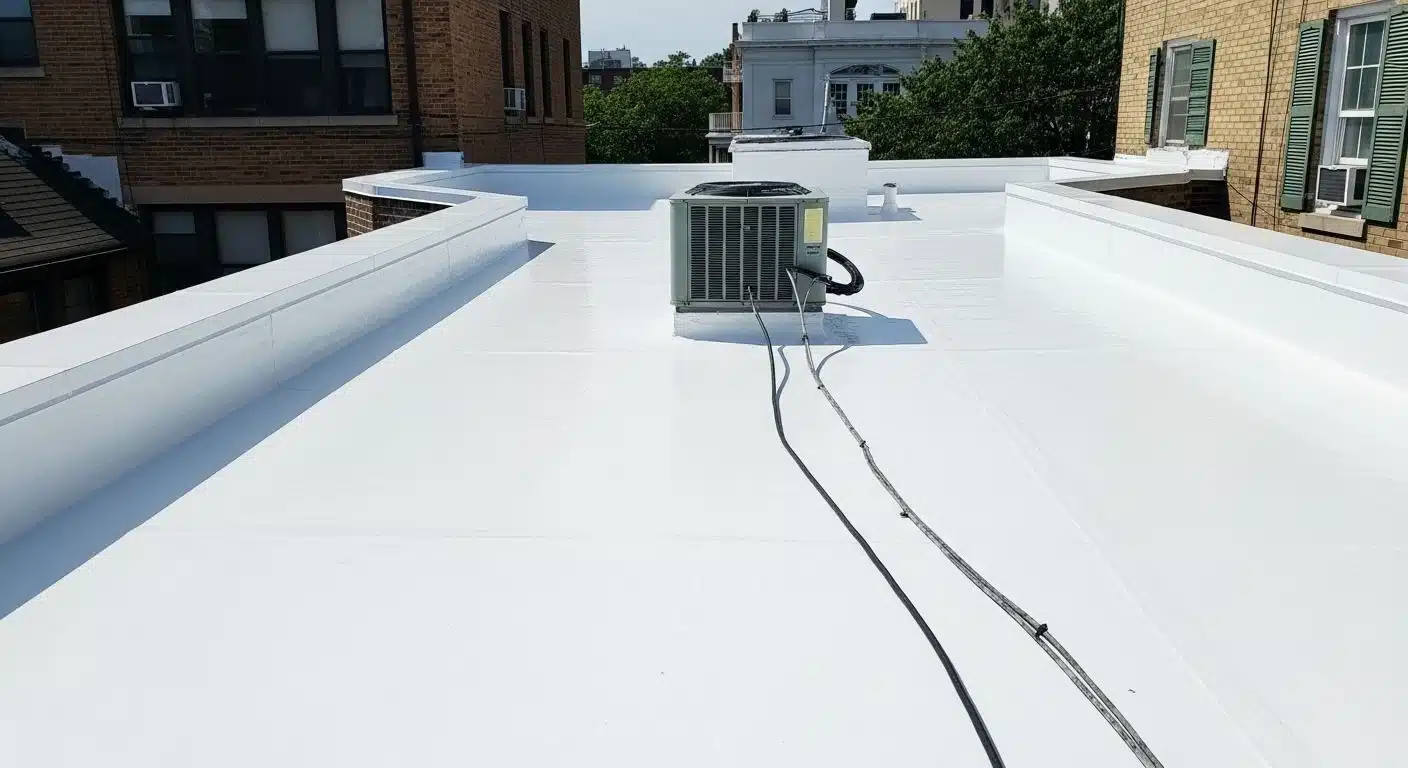
- Reflective roof coatings can reduce roof surface temperatures by up to 50 degrees Fahrenheit on a summer afternoon compared to conventional dark roofs.
- The four main Commercial Insulation types, acrylic, silicone, polyurethane, and asphaltic rubber membrane, each have different material costs, durability profiles, and suitability for Central Valley conditions.
- Proper surface preparation can account for a meaningful portion of total project cost, especially on older buildings with deteriorating substrates.
How Building Size Drives Roof Coating Costs
When our team evaluates a Commercial Insulation project in Exeter, the total roof area is the first number we calculate. This is because roofing contractors in the U.S. typically estimate projects on a per-square-foot basis, meaning the total price is the product of the roof’s square footage and the applied rate. A 10,000 square foot warehouse will always require more coating material, more primer, more equipment time, and more labor than a 3,000 square foot retail space, even when both buildings use the exact same coating system.
But size alone does not tell the whole story. The per-square-foot rate itself can shift depending on the scale of the project. Larger buildings tend to receive better per-square-foot pricing for several practical reasons. Material suppliers often offer volume discounts on coating products purchased in bulk quantities. Our crews can work more efficiently on a single large, open roof plane than on multiple small projects scattered across different locations. Equipment mobilization, which represents a fixed cost for any job, gets distributed across more square footage on a larger building, effectively lowering the per-square-foot overhead burden.
| Building Size Range | Typical Scale Considerations | Per-Square-Foot Rate Trend |
|---|---|---|
| Under 5,000 sq ft | Higher mobilization cost per sq ft, less volume purchasing power | Higher rate |
| 5,000 to 15,000 sq ft | Moderate volume efficiencies, standard crew deployment | Moderate rate |
| 15,000 to 50,000 sq ft | Strong volume discounts, efficient large-crew workflows | Lower rate |
| Over 50,000 sq ft | Maximum material purchasing leverage, multi-day streamlined operations | Lowest rate |
Roof Complexity Matters Just As Much As Square Footage
Two buildings with identical square footage can have very different coating costs. A simple, rectangular warehouse with a single low-slope roof plane and minimal rooftop equipment will be significantly less expensive to coat than an L-shaped office complex of the same size with multiple roof levels, numerous HVAC units, skylights, vent stacks, and parapet walls.
Every penetration and irregularity on the roof surface requires additional labor. Our technicians must hand-detail around vents, pipes, curbs, and equipment bases to ensure complete coverage and adhesion. Complex roof geometries also create more edges, corners, and transitions where coating application is slower and more material-intensive. In some cases, complex layouts may result in higher material waste as well, since spray application around obstacles inevitably results in some overspray.
The condition of the existing roof surface plays a comparable role. A newer roof in good condition may only need a thorough cleaning and primer before coating. An older roof with cracks, blistering, loose membrane, or ponding water issues will require extensive surface preparation, which could include pressure washing, spot repairs, flashing replacement, and additional primer coats. On buildings where the substrate has deteriorated significantly, the cost of preparation can rival or exceed the cost of the coating application itself.
Coating Type and Central Valley Climate Performance
The type of coating selected for a commercial building in Exeter has a substantial impact on both the upfront cost and the long-term return on investment. The Central Valley’s hot, dry summers and mild, wet winters create specific performance demands that make certain coating types more appropriate than others.
Acrylic coatings are the most economical option and provide excellent UV reflectivity. Studies have shown that properly formulated acrylic coatings can reduce roof surface temperatures by approximately 20 degrees Fahrenheit when exposed to direct sunlight at 85 degrees ambient temperature. However, acrylic coatings cannot withstand ponding water and may lose thickness over time due to weathering, which is a consideration during the Central Valley’s winter rain season.
Silicone coatings offer superior resistance to ponding water and perform well in extreme temperatures. They provide excellent UV protection and high reflectivity, making them well suited for Exeter’s intense summer sun. Silicone coatings do tend to collect dirt on their surface over time, which can gradually reduce their reflectivity if not maintained.
Polyurethane coatings deliver the best impact resistance and foot traffic durability of all coating types. They are typically applied as a base-and-topcoat system, with an aromatic base layer and an aliphatic top layer that provides UV stability. This makes polyurethane a strong choice for commercial buildings with regular rooftop maintenance access or equipment traffic.
Fluid-applied asphaltic rubber membrane systems form a monolithic, seamless membrane that provides instant waterproofing capability. These systems can be applied in thicknesses ranging from 20 to 200 mils dry and combine the elasticity of rubber with waterproofing properties, offering long-term protection at an economical rate for buildings with existing roof deterioration.
California Title 24 Compliance and Why It Matters in Exeter
Any Commercial Insulation project in Exeter must account for California’s Title 24, Part 6 Building Energy Efficiency Standards. The Cool Roof Rating Council confirms that the 2025 Energy Code, effective January 1, 2026, requires roofing materials used in new construction, additions, and alterations, including roof recoverings, on nonresidential buildings to meet specific solar reflectance and thermal emittance values based on climate zone.
Exeter falls within California Climate Zones that are subject to some of the strictest cool roof requirements in the state. For low-sloped Commercial Insulation in these climate zones, the prescriptive standard requires a minimum aged solar reflectance of 0.63 and a minimum thermal emittance of 0.75, or a minimum Solar Reflectance Index (SRI) of 75. These standards apply when re-roofing or replacing more than a certain percentage of the existing roof area. Choosing a coating system that meets or exceeds these requirements from the start avoids compliance issues and ensures the building operates at peak energy efficiency.
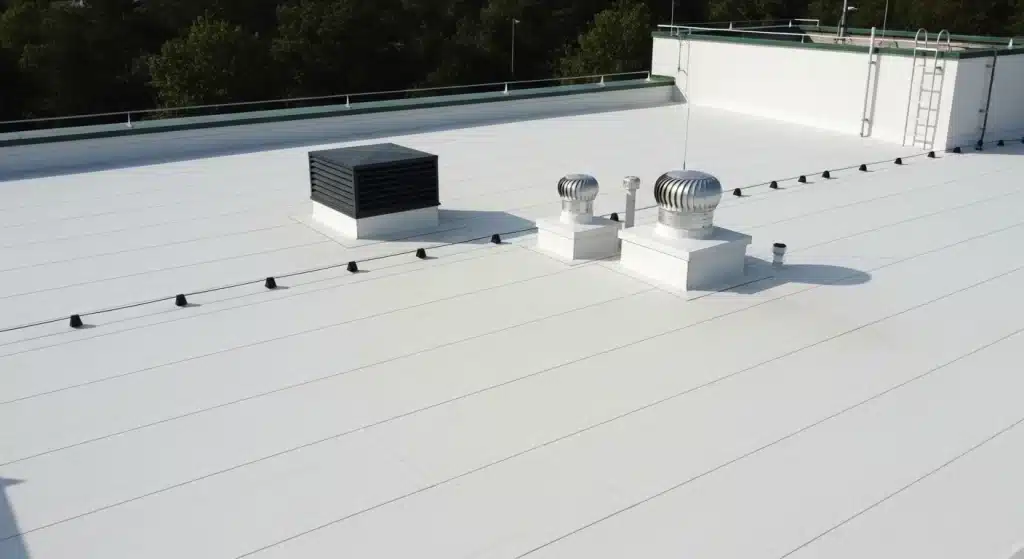
The energy savings from cool roof coatings in hot climates like the Central Valley are well documented. According to ENERGY STAR, a clean white roof that reflects 80 percent of sunlight will stay approximately 50 degrees Fahrenheit cooler than a grey roof that reflects only 20 percent of sunlight on a typical summer afternoon. The U.S. Department of Energy notes that this temperature reduction directly translates to lower cooling energy demand and can extend the service life of the roof materials by reducing thermal cycling stress.
Research from Lawrence Berkeley National Laboratory further supports this, showing that cooling energy savings from reflective roofs are highest in hot climates and that the difference between a highly absorptive dark roof and a high-albedo reflective roof can reach up to 90 degrees Fahrenheit in surface temperature differential. For Exeter commercial building owners paying for air conditioning through the long summer months, these savings compound year after year.
Recommendations by Building Type
The right coating approach depends on the building type, its operational needs, and its roof condition. Here is guidance tailored to common commercial building categories found in and around Exeter.
| Building Type | Recommended Coating Approach | Key Considerations |
|---|---|---|
| Warehouse / Distribution | Silicone or acrylic | Large open roof planes benefit from economies of scale; ponding water resistance important for flat roofs |
| Retail / Strip Mall | Acrylic or silicone | Moderate roof complexity; energy savings from reflectivity benefit air-conditioned customer spaces |
| Office Building | Polyurethane | Higher foot traffic for HVAC maintenance; premium UV stability maintains appearance |
| Agricultural Facility | Silicone or asphaltic rubber | Exposure to chemicals, fertilizers, and ponding water; durability under harsh conditions |
| Industrial / Manufacturing | Polyurethane or silicone | Impact resistance for equipment access; chemical resistance for process environments |
Smaller buildings, such as standalone retail units or small office spaces under 5,000 square feet, should not assume that coating is not worthwhile. Even at a higher per-square-foot rate, the total project cost remains modest compared to full roof replacement, and the energy savings and extended roof life deliver a strong return. The key is selecting a coating that matches both the building’s environmental exposure and its operational requirements.
Signs You Have Found the Right Roof Coating Contractor
Evaluating a roofing contractor for a Commercial Insulation project in Exeter goes beyond comparing price quotes. There are several qualitative indicators that separate a thorough, professional approach from a superficial one.
A strong contractor will conduct a detailed roof inspection before providing any estimate. This inspection should include moisture surveys, core samples if warranted, and a thorough assessment of the existing membrane condition, drainage patterns, and all rooftop penetrations. If a contractor provides a price based only on square footage without stepping foot on the roof, that is a warning sign.
Transparency about coating selection is another important marker. The contractor should explain why a specific coating type is recommended for your building, referencing factors like ponding water history, UV exposure, foot traffic requirements, and Title 24 compliance. According to FacilitiesNet, not all coatings are compatible with all roof surfaces, and facility managers should examine manufacturer material data sheets to confirm suitability for their specific project.
Communication quality matters throughout the process. A professional contractor provides a clear, written scope of work, specifies the exact coating products and manufacturer warranty terms, outlines the surface preparation plan, and sets realistic expectations for project timeline and any operational disruptions. They should also be willing to explain the warranty in plain language, including what is covered, what voids coverage, and whether the warranty is prorated over time.
Get an Accurate Assessment for Your Exeter Commercial Building
Supreme Spray Foam Fresno provides comprehensive Commercial Insulation services throughout the Exeter area, including detailed roof inspections, coating system recommendations tailored to your building type and Central Valley climate conditions, and full project management from surface preparation through final coating application. Our team understands California Title 24 compliance requirements and ensures every coating system we install meets or exceeds the applicable energy code standards.
Call us at (559) 545-0800 or email [email protected] to discuss your building’s specific needs and get a project assessment based on actual roof conditions, not guesswork.
FAQs
Does a larger commercial building always cost more to coat than a smaller one?
Yes, the total cost increases with building size because more material and labor are required. However, the per-square-foot rate often decreases on larger projects due to volume purchasing and operational efficiencies.
How does roof complexity affect coating cost compared to building size?
A small building with a complex roof layout, multiple penetrations, and poor substrate condition can cost more per square foot than a much larger building with a simple, open roof plane in good condition.
Do Commercial Insulation in Exeter need to meet California Title 24 requirements?
Yes. When re-roofing or replacing a significant portion of a Commercial Insulation in Exeter’s climate zone, the coating system must meet specific aged solar reflectance and thermal emittance values, or an equivalent Solar Reflectance Index, as outlined in the 2025 Energy Code.
Which roof coating type works best for Central Valley heat?
Silicone coatings perform particularly well in hot climates because they resist ponding water and provide strong UV protection. Acrylic coatings also offer excellent reflectivity at a lower material cost, though they cannot tolerate standing water.
Can roof coatings reduce my commercial building’s cooling costs in Exeter?
Reflective coatings can lower roof surface temperatures by up to 50 degrees Fahrenheit compared to dark, absorptive roofs. This reduction in heat transfer directly decreases the cooling load on air conditioning systems, which is especially beneficial during Central Valley summers.
Sources
- U.S. Department of Energy – Cool Roofs – Comprehensive overview of cool roof benefits, energy savings, and material options for residential and commercial buildings.
- ENERGY STAR – Cool Roofs – Data on roof reflectivity performance and temperature reduction from cool roof coatings, referencing Lawrence Berkeley National Lab research.
- Lawrence Berkeley National Laboratory – Impact of Reflectivity and Emissivity on Building Energy Use – Research on how roof albedo and emissivity affect cooling and heating energy consumption across multiple U.S. climate zones.
- Cool Roof Rating Council – California Title 24 Requirements – Detailed breakdown of California’s 2025 Building Energy Efficiency Standards for cool roofs, including requirements by climate zone and roof slope for nonresidential buildings.
- FacilitiesNet – 4 Types of Roof Coatings: How to Pick the Best for Your Facility – Technical comparison of acrylic, silicone, polyurethane, and asphaltic rubber roof coating properties, applications, and limitations for commercial facilities.

- What Makes Crawl Space Spray Foam a Choice for Better Air Quality in Oakhurst, CA? - September 22, 2026
- Crawl Space Spray Foam: Types, Benefits, Costs, Installation, and Guide - September 22, 2026
- How Long Should Spray Foam Insulation Last Before It Needs to Be Repaired in Ahwahnee, CA? - September 11, 2026