
If you live in Exeter, you already know the drill. Summer afternoons push past 100 degrees, and your air conditioning unit works overtime to keep your home livable. Your utility bill shows up a few weeks later like a second mortgage payment, and you wonder where all that money is actually going. The answer, more often than not, is sitting right above your head.
Your attic is the single largest source of energy waste in most homes. In fact, data from the U.S. Energy Information Administration – Use of Energy in Homes shows that space heating and air conditioning account for 52% of a household’s annual energy consumption. When your attic lacks proper insulation and air sealing, the conditioned air you paid for escapes through gaps, cracks, and thin ceiling material, while outside heat pours in. Your HVAC system compensates by running longer and harder, driving up your monthly bills in a cycle that never ends.
Spray foam insulation changes that equation. Unlike traditional fiberglass batts or blown-in cellulose, spray foam expands on contact to fill every crack, gap, and void in your attic. It creates a continuous air seal and a high-performance thermal barrier at the same time. According to ENERGY STAR – Methodology for Estimated Energy Savings, homeowners can save an average of 15% on heating and cooling costs by air sealing their homes and adding insulation in attics and other key areas. In a hot climate like Exeter’s, those savings tilt heavily toward cooling, which is exactly where most of your energy dollars go.
We have spent years insulating attics across the Central Valley, and we wrote this guide to walk you through everything you need to know about using spray foam to lower your energy bills. You will learn how attic spray foam insulation works, which type fits your situation, what the installation process looks like from start to finish, and how to measure the results once the work is done. Our goal is to give you a single, thorough reference you can return to at any point in your decision-making process.
TL;DR
- Exeter’s 100-degree summers make your attic the largest source of energy waste, with heating and cooling consuming 52% of household energy according to the EIA.
- Spray foam insulates and air seals in a single step, filling every crack, gap, and void to stop conditioned air from escaping and outside heat from pouring in.
- Exeter falls under IECC Climate Zone 3 and California Climate Zone 13, where code requires a minimum ceiling R-38 to R-49, depending on your attic assembly.
- The two main approaches, vented attic floor and unvented conditioned roof deck, each serve different needs, and the right choice depends largely on whether your HVAC equipment and ductwork sit in the attic.
- A proper installation follows a clear sequence: inspect for leaks and hazards, remove all existing insulation, clean and prep the surface, apply spray foam in controlled lifts, add supplemental insulation if needed, then verify with a quality inspection.
- Homeowners who air seal and insulate their attics can save an average of 15% on heating and cooling costs, with savings hitting hardest on summer cooling bills in Exeter’s hot-dry climate.
- You can measure results from day one by comparing year-over-year utility bills, watching for more even indoor temperatures, and tracking shorter HVAC run times on peak summer afternoons.
Why Your Attic Is the Biggest Energy Problem in Your Home
Before diving into solutions, it helps to understand exactly why the attic matters so much. Heat moves in three ways: conduction (through solid materials), convection (through air movement), and radiation (as direct heat energy). An uninsulated or poorly insulated attic allows all three to rob your home of efficiency.
During an Exeter summer, the sun beats down on your roof for hours. Roof surface temperatures can easily exceed 160 degrees. That heat conducts through the roofing matrials into the attic space, where it builds up like an oven. Without a proper thermal barrier between the attic and your living space, that heat transfers through the ceiling into your rooms. This is why attic insulation services are essential for controlling indoor temperatures. Your air conditioner has to fight a constant uphill battle against this radiant heat gain.
In winter, the problem reverses. Warm air from your furnace rises and escapes through the ceiling into the attic through dozens of small penetrations: gaps around light fixtures, electrical wiring, plumbing pipes, chimney chases, and the imperfect seals where drywall meets the top plates of your walls. This process, called the stack effect, continuously pulls warm air out of your home and draws cold air in through lower-level gaps.
The Department of Energy notes that spray foam insulation both insulates and air seals in a single step, filling even the smallest cavities to create an effective air barrier. This dual action is what makes spray foam so effective compared to other insulation types. Fiberglass and cellulose slow heat transfer but do not stop air movement. Spray foam does both.
How Much Energy Are You Losing?
Consider these numbers:
- 52% of all household energy goes to heating and cooling, according to EIA data
- Up to 40% of radiant heat gain in warm climates comes through poorly insulated attics
- ENERGY STAR estimates average savings of 11% on total energy costs from proper sealing and insulation
For an Exeter home with a typical summer electric bill, those percentages translate to a meaningful reduction, month after month, year after year. And unlike a new HVAC system that degrades over time, spray foam insulation maintains its performance for decades once installed correctly.
Understanding Exeter’s Climate and What It Means for Insulation
Exeter sits in California’s Central Valley, in a hot, dry climate zone. The California Energy Commission – Climate Zone Tool, Maps, and Information classifies this region under California Climate Zone 13, which corresponds to IECC Climate Zone 3. This matters because insulation requirements are calibrated to your specific climate zone, and the performance demands in Zone 3 are substantial.
In Climate Zone 3, your primary challenge is cooling load. The insulation in your attic needs to resist the relentless heat transfer from a roof baked by direct sun for most of the day. California’s Title 24 energy code reflects this by requiring specific R-values for ceiling assemblies based on the climate zone. Under the 2016 and later editions of the code, most homes in this zone need ceiling insulation achieving a U-factor of 0.025 or better, which roughly translates to an R-38 or higher for standard wood-framed assemblies.
The U-factor represents how much heat passes through a building assembly. A lower U-factor means less heat transfer. Spray foam excels at meeting and exceeding these requirements because it delivers a higher R-value per inch than most competing materials.
Spray Foam Insulation: How It Works
Spray foam insulation is created by mixing two chemical components, isocyanate and polyol resin, at the point of application. When these chemicals meet, they react and expand rapidly, filling the space where they are sprayed. Within seconds, the foam cures into a solid material that adheres to wood, metal, concrete, and other building substrates.
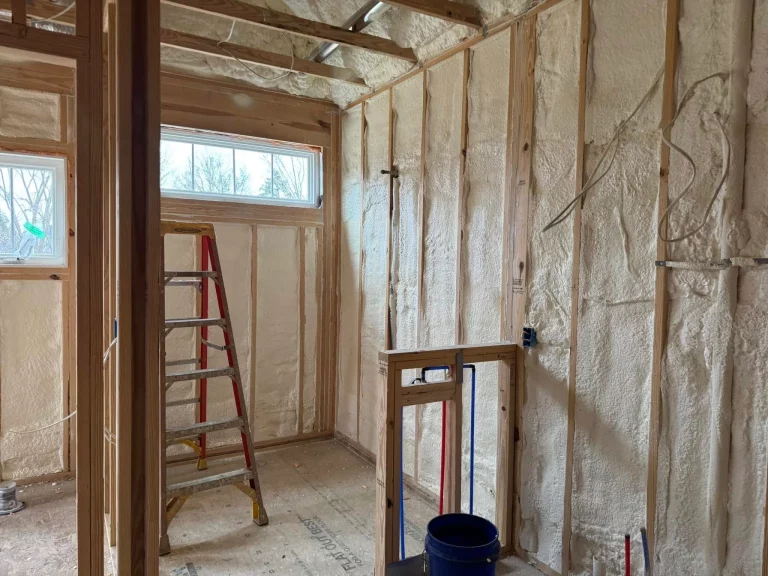
The expansion is what sets spray foam apart. As it grows, it pushes into corners, crevices, and gaps that other insulation materials simply cannot reach. It seals around nails, follows the contours of irregular framing, and bonds directly to the surfaces it touches. This creates a monolithic layer that blocks both conductive heat transfer and air movement simultaneously.
There are two main categories of spray foam insulation, and choosing the right one for your attic is one of the most important decisions in the process.
Open-Cell Spray Foam
Open-cell spray foam has a lighter, spongier texture. The cells within the foam are left open, filled with air rather than a chemical gas. This gives open-cell foam a lower density and a lower R-value per inch, typically around R-3.5 to R-3.8 per inch.
Key characteristics of open-cell spray foam:
- R-value: approximately R-3.5 per inch
- Density: 0.4 to 1.2 lbs per cubic foot
- Expansion: expands 100 to 120 times its original volume, which helps it fill large cavities quickly
- Vapor permeability: vapor-open, meaning it allows moisture vapor to pass through slowly
- Sound dampening: excellent at absorbing sound due to its spongy texture
Open-cell foam is often used in interior wall cavities and attic floors where its sound-dampening qualities are valued. Because it is vapor-permeable, it allows assemblies to dry to the interior if any moisture accumulates. However, it should not be used below grade or in areas where it might be exposed to liquid water, since the open cells can absorb moisture.
Closed-Cell Spray Foam
Closed-cell spray foam has a denser, rigid structure. The cells within the foam are closed and filled with a gas that contributes to the material’s insulating properties. This gives closed-cell foam a significantly higher R-value per inch, typically around R-6.0 to R-7.0 per inch.
Key characteristics of closed-cell spray foam:
- R-value: approximately R-6.0 to R-7.0 per inch
- Density: 1.5 to 2.0+ lbs per cubic foot
- Expansion: expands approximately 30 to 35 times its original volume
- Vapor retarder: acts as a Class II vapor retarder at 2 inches or more
- Structural strength: adds rigidity to the assemblies it is applied to
Closed-cell foam is preferred for attic floor applications where its higher R-value per inch allows you to achieve code-required insulation levels in less space. Its moisture-resistant properties also make it a strong choice in climates where humidity control matters. According to the DOE Building America Solution Center – Spray Foam Insulation Applied to Existing Attic Floor, closed-cell spray foam is the recommended product for attic floor air barrier applications because it can be applied in a consistent one-inch layer without the billowing and voids that sometimes occur with open-cell foam.
Comparing the Two Types
| Feature | Open-Cell Spray Foam | Closed-Cell Spray Foam |
|---|---|---|
| R-value per inch | ~R-3.5 | ~R-6.5 |
| Density | Lower (lighter) | Higher (heavier) |
| Vapor permeability | Vapor-open | Vapor-retarder |
| Sound dampening | Excellent | Good |
| Structural support | None | Adds rigidity |
| Moisture resistance | Can absorb water | Resists moisture |
| Best attic use | Roof deck (unvented) | Attic floor (vented) |
Expert Tip: If your attic has a low-pitch roof with limited space between the ceiling joists and the roof deck, closed-cell spray foam is usually the better choice. Its higher R-value per inch means you can meet insulation requirements without running out of room. If you are converting your attic to a conditioned space by insulating along the roof line, open-cell foam can be a cost-effective option that fills the rafter bays fully.
Two Approaches to Insulating Your Attic with Spray Foam
There are fundamentally two ways to use spray foam in an attic. The right choice depends on your home’s construction, your goals, and whether you have HVAC equipment located in the attic space.
Approach 1: Vented Attic with Spray Foam on the Attic Floor
This is the most common approach for existing homes. The attic remains a vented space above the insulation, and the thermal boundary is established at the ceiling plane, which is also the attic floor.
How it works: Spray foam (typically closed-cell) is applied directly to the attic floor, covering the ceiling drywall, the ceiling joists, and the wall top plates. This creates a continuous air barrier that seals all the gaps and penetrations where air normally leaks from your living space into the attic. Additional loose-fill or batt insulation is then installed over the spray foam layer to bring the total R-value up to code requirements.
The DOE Building America Solution Center outlines a clear step-by-step process for this approach: existing insulation is removed first, the ceiling surface is cleaned of debris and dust, and then at least 1 inch of closed-cell spray foam is applied as a continuous air control layer. After the foam cures, additional fibrous insulation is blown or laid on top to reach the target R-value.
Advantages of the vented attic approach:
- Works with most existing home designs without major structural changes
- Soffit and ridge vents continue to manage attic temperature and moisture
- Lower total material cost than insulating the entire roof deck
- Well-understood by building inspectors and code officials
Best for: Most existing homes in Exeter that have traditional vented attics and HVAC equipment located outside the attic space.
Approach 2: Unvented Conditioned Attic with Spray Foam on the Roof Deck
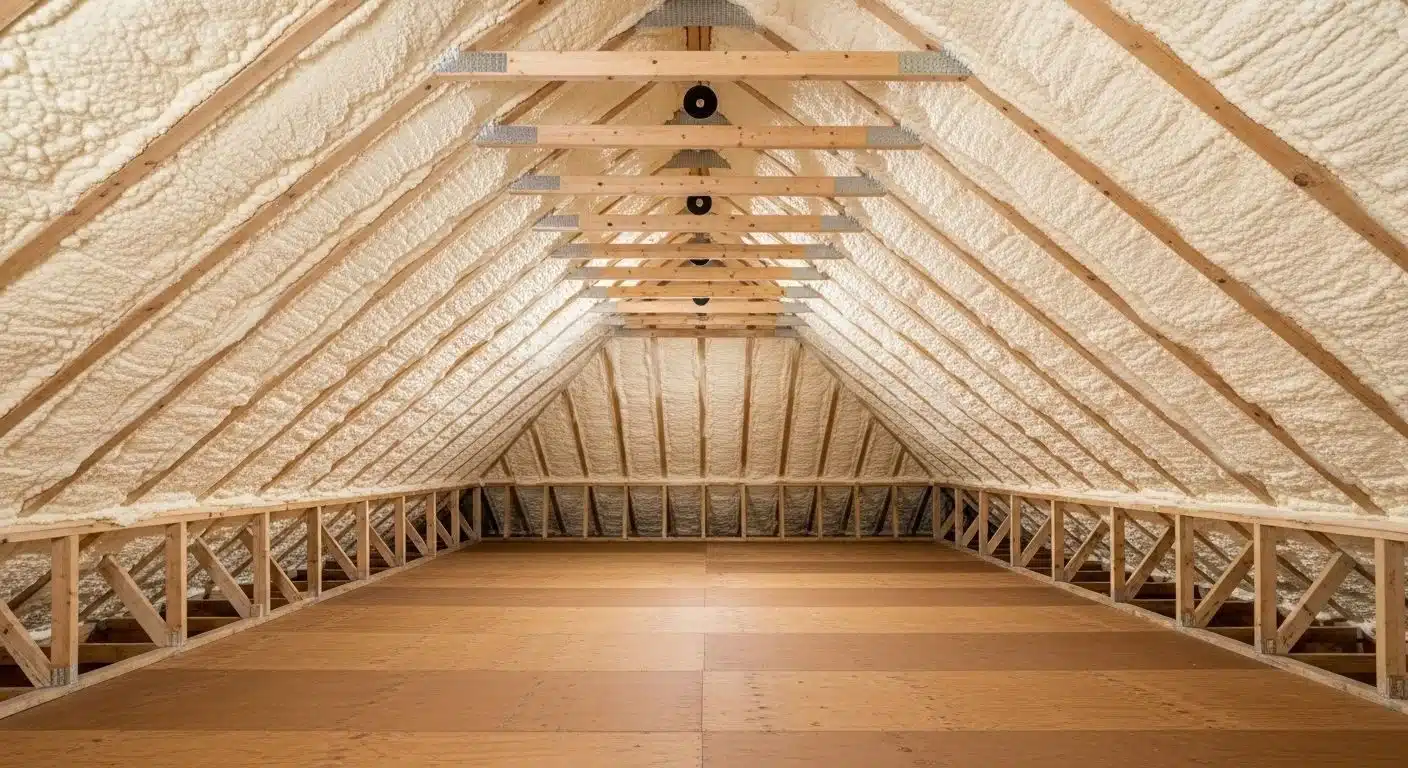
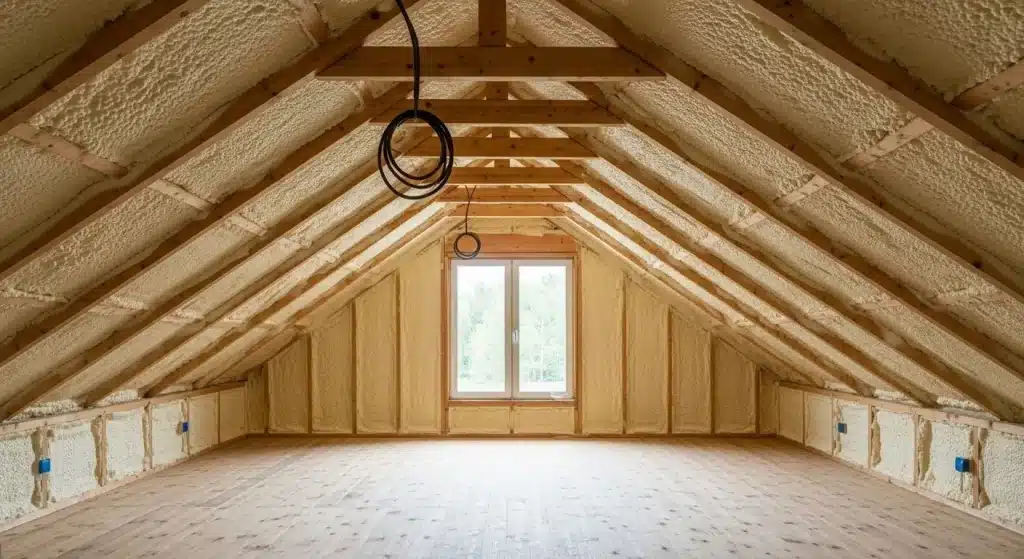
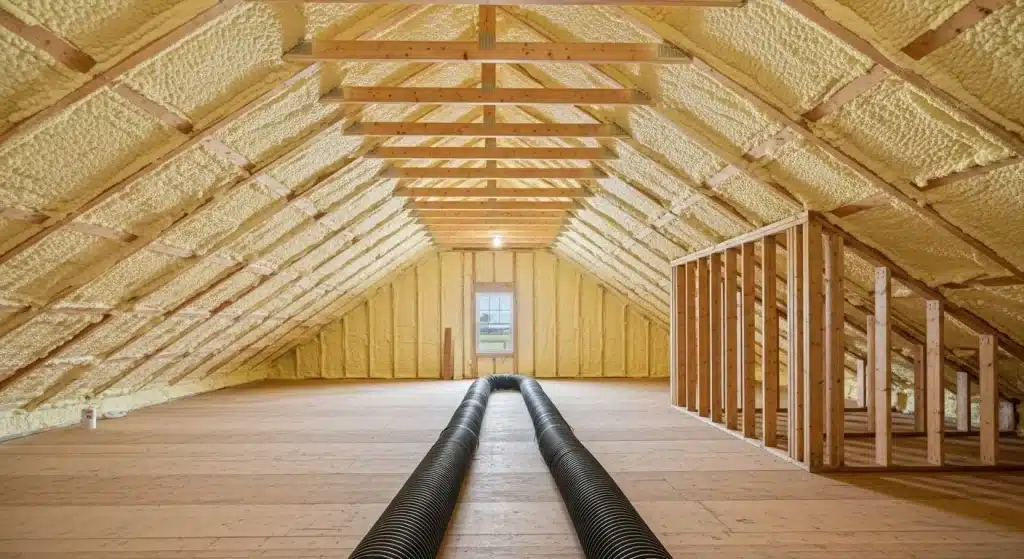
In this approach, spray foam is applied directly to the underside of the roof sheathing, and the attic is sealed and brought into the conditioned space of the home. Soffit vents are sealed, and the attic becomes part of the thermal envelope.
The DOE Building America Solution Center – Unvented Conditioned Attic with Spray Foam Insulation Below Roof Deck describes how either open-cell or closed-cell spray foam is sprayed along the underside of the roof deck to create an unvented, insulated, conditioned attic. This approach has been used since the mid-1990s and offers several advantages in specific situations.
Advantages of the unvented conditioned attic:
- HVAC ducts and equipment in the attic operate within conditioned space, eliminating massive energy losses from ductwork in extreme temperatures
- Provides a tempered, conditioned space for storage or future living space
- No soffit vents means no entry path for wildfire embers, a real consideration in California
- Eliminates ice dam risk in colder climates and reduces wind-driven rain intrusion in high-wind areas
- Works well for homes with complex ceiling geometries, coffered ceilings, or numerous skylight penetrations that make air sealing at the ceiling plane impractical
Best for: New construction, homes with HVAC equipment and ductwork in the attic, homes with complex ceiling designs, and homeowners in wildfire-prone areas who want to eliminate vent openings.
Expert Tip: If your home has ductwork running through the attic, moving the thermal boundary to the roof deck by creating an unvented conditioned attic can eliminate up to 20% of your HVAC energy waste. Ducts in a vented attic lose a significant amount of the conditioned air they carry, especially in summer when attic temperatures can exceed 140 degrees.
Step-by-Step: The Spray Foam Insulation Process for Your Attic
Whether you choose the vented attic floor approach or the unvented roof deck approach, the installation process follows a general sequence. Here is what to expect from start to finish.
Step 1: Initial Inspection and Assessment
Before any insulation work begins, a thorough inspection of the attic is essential. Our team evaluates the existing conditions, looking for:
- Roof leaks: Any active leaks must be repaired before insulation is added, because trapping moisture against wood can cause rot and mold growth.
- Knob and tube wiring: Older wiring in the attic must be identified and addressed. Insulating over active knob and tube wiring is a fire hazard.
- Hazardous materials: Older homes may contain vermiculite insulation, which can carry asbestos. Any suspected hazardous materials need professional remediation before work proceeds.
- Bathroom and kitchen exhaust fans: These must vent to the exterior, not into the attic space. If fans are dumping humid air into the attic, the ducting needs to be rerouted before insulation is installed.
- Existing insulation condition: We check the type, depth, and condition of existing insulation to determine whether it can remain or needs to be removed.
- Structural assessment: The framing members are evaluated for damage, rot, or weakness that could affect the installation.
Step 2: Preparing the Attic
Preparation is where a lot of the real work happens, and it is often the step that separates a quality installation from a poor one.
For a vented attic (attic floor approach):
- Remove all existing insulation from the attic floor. This exposes the ceiling drywall so the spray foam can adhere directly to it.
- Sweep or vacuum the entire ceiling surface. Dust, debris, bits of old plaster, and construction residue prevent proper foam adhesion.
- Install baffles at each soffit vent location. Baffles maintain a clear pathway for ventilation air to flow from the soffit vents up past the insulation to the ridge or exhaust vents. Without baffles, insulation can block the soffit vents, cutting off attic ventilation and creating moisture problems.
- Seal large penetrations with rigid blocking or sheet metal. Around chimney flues, large plumbing chases, and open soffit areas, solid blocking provides a substrate the spray foam can seal against.
- Cover non-ICAT-rated recessed lights with approved covers. Standard recessed can lights are essentially holes in your ceiling that allow air to pour into the attic. Covers that are rated for insulation contact and airtight construction (ICAT) solve this problem.
For an unvented attic (roof deck approach):
- Clean the underside of the roof sheathing and structural members so they are free of dust and debris.
- Cover mechanical and electrical equipment and wiring.
- Seal all penetrations through the attic floor from the living space below.
- Verify the roof has proper drainage protection above the roof deck.
Expert Tip: One of the most common mistakes in attic insulation is leaving existing insulation in place and spraying foam over it. The DOE Building America Solution Center explicitly warns against this, noting that debris, old insulation, and dust will interfere with spray foam adhesion and prevent an effective air seal. Always remove the old material first.
Step 3: Applying the Spray Foam
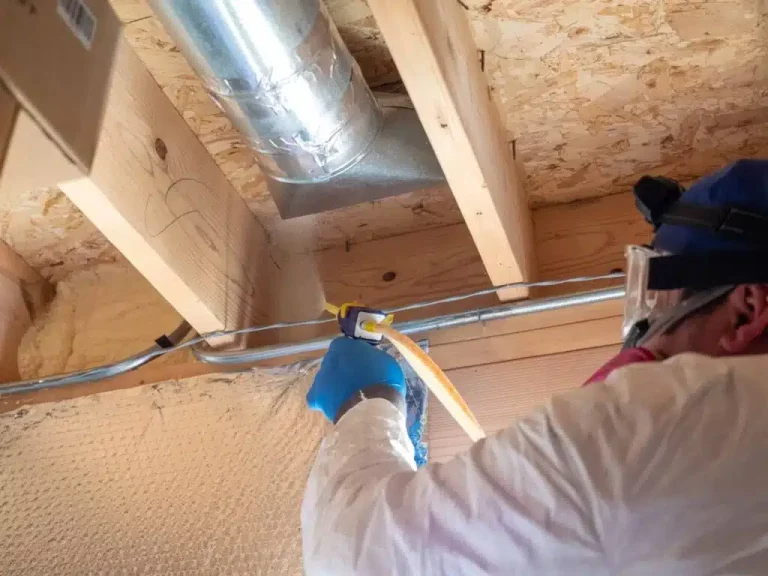
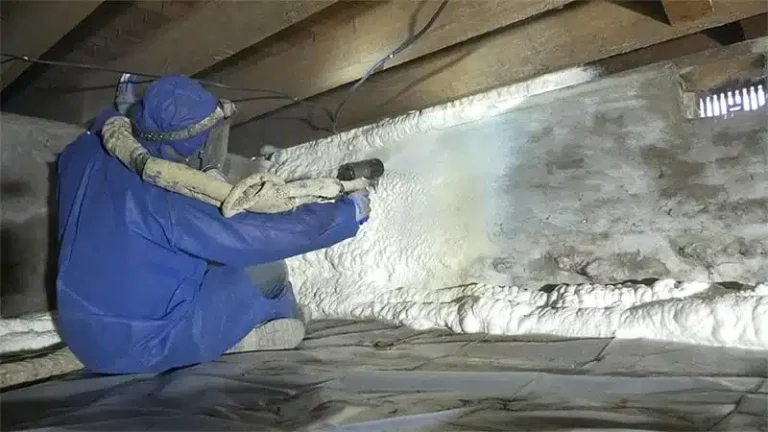
This is the stage where the transformation happens. Trained installers wearing full protective equipment use specialized spray rigs to apply the foam.
For the attic floor approach:
- At least 1 inch of closed-cell spray foam is applied across the entire ceiling plane, covering the drywall, ceiling joists, and wall top plates. This layer creates the continuous air control layer.
- The foam is sprayed in passes called lifts, with each lift allowed to cure before the next is applied. Controlling lift thickness is critical for proper curing and consistent R-value.
- At the eaves where the roof pitch is low, the rafter bays are filled completely with spray foam up to the baffles to ensure adequate insulation over the top plates of the walls.
For the roof deck approach:
- Spray foam is applied directly to the underside of the roof sheathing, filling the rafter bays. Either open-cell or closed-cell foam can be used, depending on the R-value requirements and moisture control needs of the project.
- The foam is applied to the specified thickness to meet or exceed local building code R-value requirements.
- Gable end walls and any skylight framing are also sealed and insulated to complete the thermal envelope.
[Image: Professional installer applying closed-cell spray foam to an attic floor, showing consistent coverage over ceiling joists and drywall]
Step 4: Additional Insulation Layer (If Required)
For the vented attic floor approach, the spray foam layer is often supplemented with additional insulation. After the 1-inch spray foam air barrier cures, loose-fill fiberglass or cellulose is blown over the top to bring the total assembly R-value up to the level required by the current building code. For Climate Zone 3 in California, this typically means achieving a total ceiling R-value of approximately R-38 or higher.
For the unvented roof deck approach, the spray foam alone may be sufficient, or additional cavity insulation can be added between the foam and the ceiling drywall below to increase the total R-value.
Step 5: Quality Inspection and Verification
After installation is complete, the work is inspected for:
- Consistent foam thickness with no gaps, voids, or thin spots
- Complete coverage of the ceiling plane or roof deck
- Proper sealing of all penetrations and transitions
- Correct baffles installation and clear ventilation pathways (for vented attics)
- Compliance with local building code requirements
Some installers use infrared thermography or blower door testing to verify that the air barrier is continuous and performing as designed. These diagnostic tools can identify any remaining air leaks that need attention.
Choosing the Right R-Value for Your Exeter Home
R-value measures how well a material resists heat flow. Higher R-values mean better insulation performance. The R-value you need depends on your climate zone and whether you are insulating the attic floor or the roof deck.
For Exeter, located in IECC Climate Zone 3, the general recommendations from the DOE Building America Solution Center and the 2012 IECC are:
| Assembly Location | Minimum R-Value (IECC 2012) | Minimum R-Value (IECC 2015+) |
|---|---|---|
| Attic floor (vented) | R-38 | R-49 or U-0.026 |
| Roof deck (unvented, air-impermeable insulation) | R-25 (with ccSPF) | R-25 or higher |
California’s Title 24 energy code has its own specific requirements that may be more stringent than the IECC baseline. The exact requirements depend on which edition of Title 24 applies to your home and whether you follow the prescriptive path or the performance path for compliance.
Expert Tip: Do not just aim for code minimum. The Department of Energy notes that the maximum thermal performance of insulation depends heavily on proper installation. Even the best insulation underperforms if it is compressed, gapped, or installed without a proper air seal. This is why spray foam, which eliminates gaps and air movement as part of its installation, often outperforms code-minimum fiberglass installations that were not carefully put in place.
Measuring Your Results: How to Track Energy Savings
After your spray foam insulation is installed, you want to know whether the investment is paying off. Here are practical ways to measure the impact on your energy bills and home comfort.
Compare Year-Over-Year Utility Bills
The simplest approach is to compare your energy bills before and after the installation. For the most accurate comparison, use bills from the same months in consecutive years. Summer bills in Exeter are the most telling, since that is when the cooling load peaks.
To make a fair comparison, account for:
- Differences in outdoor temperature between the two periods (degree-day data from the National Weather Service)
- Changes in electricity rates
- Any new appliances or changes in household occupancy
- Thermostat settings
Monitor Indoor Temperature Consistency
Before insulation, many homeowners notice hot and cold spots throughout their house. Rooms farther from the thermostat, rooms on the upper floor, and rooms with exterior walls facing west tend to be less comfortable. After spray foam insulation, these temperature swings should diminish noticeably because the air seal prevents the uncontrolled mixing of attic and living-space air.
Track HVAC Runtime
If you have a smart thermostat, you can track how often your air conditioning system cycles. Before spray foam insulation, your system may have run for long stretches without reaching the set temperature, especially on hot afternoons. After insulation, you should see shorter run times and the system reaching the target temperature more quickly.
Professional Energy Audit
For a detailed assessment, a home energy audit conducted by a certified professional can measure your home’s air infiltration rate using a blower door test. This gives you an objective, quantifiable number that shows exactly how much the spray foam has improved your home’s airtightness.
Common Challenges and How We Address Them
Every attic presents its own set of complications. After years of working in Central Valley homes, here are the issues we encounter most frequently and how they are resolved.
Low-Slope Roofs and Limited Clearance
Many homes in the Exeter area were built with low-pitch roofs that leave very little space between the ceiling and the roof deck at the eaves. This makes it difficult to achieve the required R-value with standard insulation. Closed-cell spray foam solves this problem because of its high R-value per inch. Where a traditional blown-in insulation might need 14 to 16 inches to reach R-49, closed-cell foam can achieve the same performance in roughly 7 to 8 inches.
HVAC Equipment in the Attic
Homes with air handlers and ductwork in the attic face a particularly expensive form of energy waste. When ducts run through a 140-degree vented attic in summer, a significant portion of the cooled air they carry is lost to the surrounding heat, even if the ducts are insulated. Two solutions exist: either move the thermal boundary to the roof deck by creating an unvented conditioned attic, or encapsulate the ductwork in spray foam and bury it beneath the attic floor insulation.
Moisture Concerns
In any insulation project, moisture management is critical. Trapping moisture against wood structures leads to rot and mold. Spray foam installed properly actually helps manage moisture by sealing out humid attic air. For closed-cell applications, the foam itself acts as a vapor retarder. For open-cell applications in unvented attic assemblies, additional moisture control measures such as dehumidification or controlled ventilation may be needed. The DOE Building America Solution Center emphasizes that unvented conditioned attics must include a means of moisture removal, such as balanced ventilation or dehumidification.
Pest Prevention
Rodents and insects can nest in and damage traditional insulation, particularly the fiberglass batts and blown-in materials found in many attics. Spray foam, once cured, is not a food source for pests and its rigid structure (especially closed-cell) makes it difficult for rodents to tunnel through. While spray foam alone does not constitute a pest control measure, it does eliminate the soft, fibrous nesting material that attracts many common attic invaders.
What to Expect on Installation Day
Understanding the timeline and logistics of an attic spray foam project helps you prepare and set realistic expectations.
Before the crew arrives:
- Clear access to the attic hatch or pull-down stairs
- Remove any stored items from the attic space
- Park vehicles away from the driveway or garage area near where the spray rig will be set up
- Plan for the house to be occupied or unoccupied based on the installer’s recommendations (some spray foam products require a short re-entry time after application)
During installation:
- A typical attic insulation project takes one to two days, depending on the size of the attic and the amount of preparation needed
- The spray rig is typically parked outside, with hoses running into the attic
- Installers wear full personal protective equipment including respirators, suits, and gloves
- There will be a chemical odor during application. Proper ventilation is maintained, and the odor dissipates within 24 to 72 hours after curing is complete
- You may hear the spray equipment operating from inside the house
After installation:
- The spray foam continues to cure for 24 to 48 hours, reaching its full physical properties over several days
- The crew conducts a visual inspection of the completed work
- Any loose-fill insulation to be added over the spray foam layer is installed after the foam has cured
- You should notice a difference in indoor temperature stability within the first day or two, with full energy savings visible on your next billing cycle
Long-Term Performance and Durability
One of the strongest arguments for spray foam insulation is its longevity. Unlike fiberglass batts that can sag, settle, or be displaced by rodents and air movement, spray foam adheres permanently to the surfaces it is applied to. It does not settle over time. It does not absorb moisture (closed-cell). It does not provide nesting material for pests. It does not degrade from normal temperature cycling in the attic.
The Department of Energy notes that the maximum thermal performance of any insulation depends on proper installation, and spray foam’s ability to conform to any surface shape means that, when installed correctly, it delivers consistent, gap-free performance for the life of the building.
Properly installed spray foam also contributes to other aspects of home durability:
- Reduced moisture infiltration: By sealing out humid attic air, spray foam helps protect ceiling drywall and framing from moisture-related damage.
- Improved indoor air quality: Sealing air leaks means fewer pathways for dust, allergens, and pollutants from the attic to enter your living space.
- Structural rigidity: Closed-cell spray foam adds measurable structural strength to the assemblies it is applied to, helping to resist racking and deflection.
Key Takeaways:
- Spray foam insulation is a permanent upgrade that does not settle, sag, or degrade over time when installed correctly.
- The air sealing that spray foam provides is often more important than the R-value itself in determining real-world energy savings.
- Choosing between vented and unvented attic strategies depends on your home’s specific conditions, particularly whether HVAC equipment is located in the attic.
Putting Your Attic Insulation Strategy into Action
Lowering your energy bills with spray foam insulation is not a one-day fix. It is a decision backed by building science, calibrated to your specific climate zone, and executed through a careful, multi-step process. The homes we have insulated across the Central Valley consistently show the same pattern: reduced HVAC run times, more stable indoor temperatures, and lower monthly utility bills starting from the very first full billing cycle after installation.
The steps are straightforward once you understand them. Assess your attic’s current condition. Choose the right approach, either a vented attic floor or an unvented conditioned attic, based on where your HVAC equipment lives and what your home’s construction allows. Select the spray foam type that matches your performance needs. Prepare the space thoroughly. Apply the foam with precision. Verify the results. Then enjoy the savings for decades.
This guide is here whenever you need to reference it. Whether you are just starting to research your options or you are ready to schedule an installation, the principles and process described here apply to your home in Exeter.
Need Expert Guidance?
If you are ready to explore spray foam insulation for your attic, our team at Supreme Spray Foam Fresno is here to help. We serve Exeter and the surrounding Central Valley communities with professional spray foam installation backed by years of field experience. Reach out to us at [email protected] or call (559) 545-0800 to schedule an inspection and get a detailed assessment of your attic’s insulation needs.
Frequently Asked Questions About Attic Spray Foam Insulation in Exeter
How long does spray foam insulation last?
Spray foam insulation is designed to last the lifetime of the building. It does not settle, shrink, or degrade under normal conditions.
Does spray foam require a thermal barrier or ignition barrier?
Yes. Building codes require an approved thermal barrier, typically half-inch gypsum board, over all spray foam insulation in occupied spaces. In some attic applications, an ignition barrier coating may be used instead. The specific requirement depends on the foam type, location, and applicable code.
Will my home need additional ventilation after spray foam is installed?
It depends on the approach. Vented attics maintain their existing ventilation. Unvented conditioned attics require a different ventilation strategy, such as bringing a small amount of conditioned air from the living space into the attic or using a balanced ventilation system.
Can spray foam be installed over existing insulation?
Generally, no. The existing insulation needs to be removed so the spray foam can adhere directly to the ceiling surface or roof deck for a proper air seal.
Is there a smell after installation, and is it safe?
There is an odor during application and for 24 to 72 hours afterward. Installers follow manufacturer re-entry guidelines to ensure occupant safety. Proper ventilation during and after curing resolves this.
Does spray foam insulation help with noise reduction?
Open-cell spray foam is particularly effective at absorbing sound. If noise reduction between rooms or from the exterior is a priority, open-cell foam provides an added acoustic benefit beyond thermal insulation.
Sources
- ENERGY STAR – Methodology for Estimated Energy Savings – EPA’s methodology and savings estimates for home sealing and insulation improvements
- U.S. Energy Information Administration – Use of Energy in Homes – Data on residential energy consumption by end use, including heating and cooling percentages
- DOE Building America Solution Center – Spray Foam Insulation Applied to Existing Attic Floor – Detailed step-by-step installation guidance for vented attic floor spray foam applications
- DOE Building America Solution Center – Unvented Conditioned Attic with Spray Foam Insulation Below Roof Deck – Comprehensive guide for unvented conditioned attic spray foam installations
- California Energy Commission – Climate Zone Tool, Maps, and Information – California’s climate zone designations and the building energy efficiency standards that depend on them

- What Makes Crawl Space Spray Foam a Choice for Better Air Quality in Oakhurst, CA? - September 22, 2026
- Crawl Space Spray Foam: Types, Benefits, Costs, Installation, and Guide - September 22, 2026
- How Long Should Spray Foam Insulation Last Before It Needs to Be Repaired in Ahwahnee, CA? - September 11, 2026