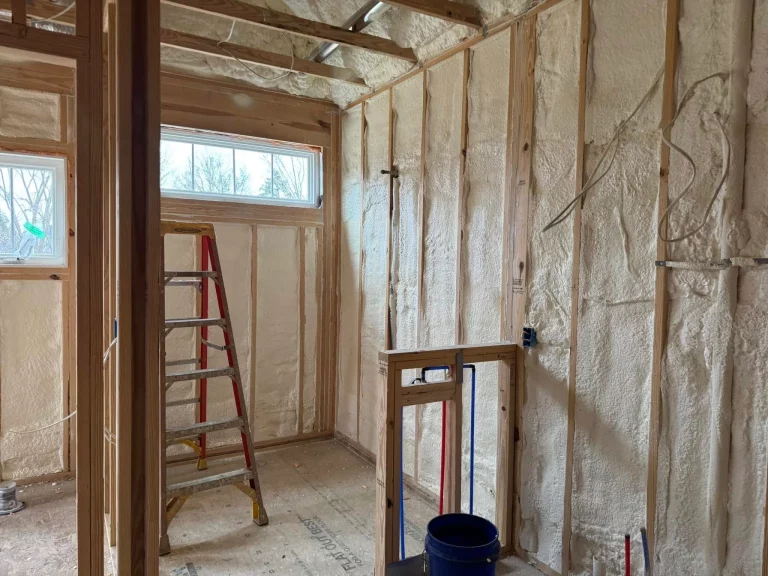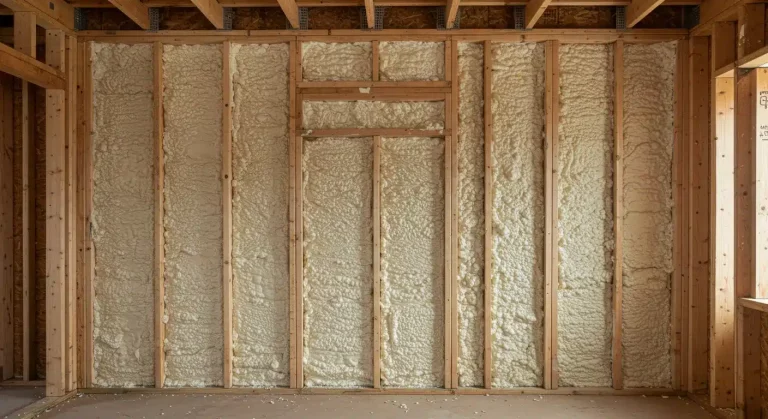

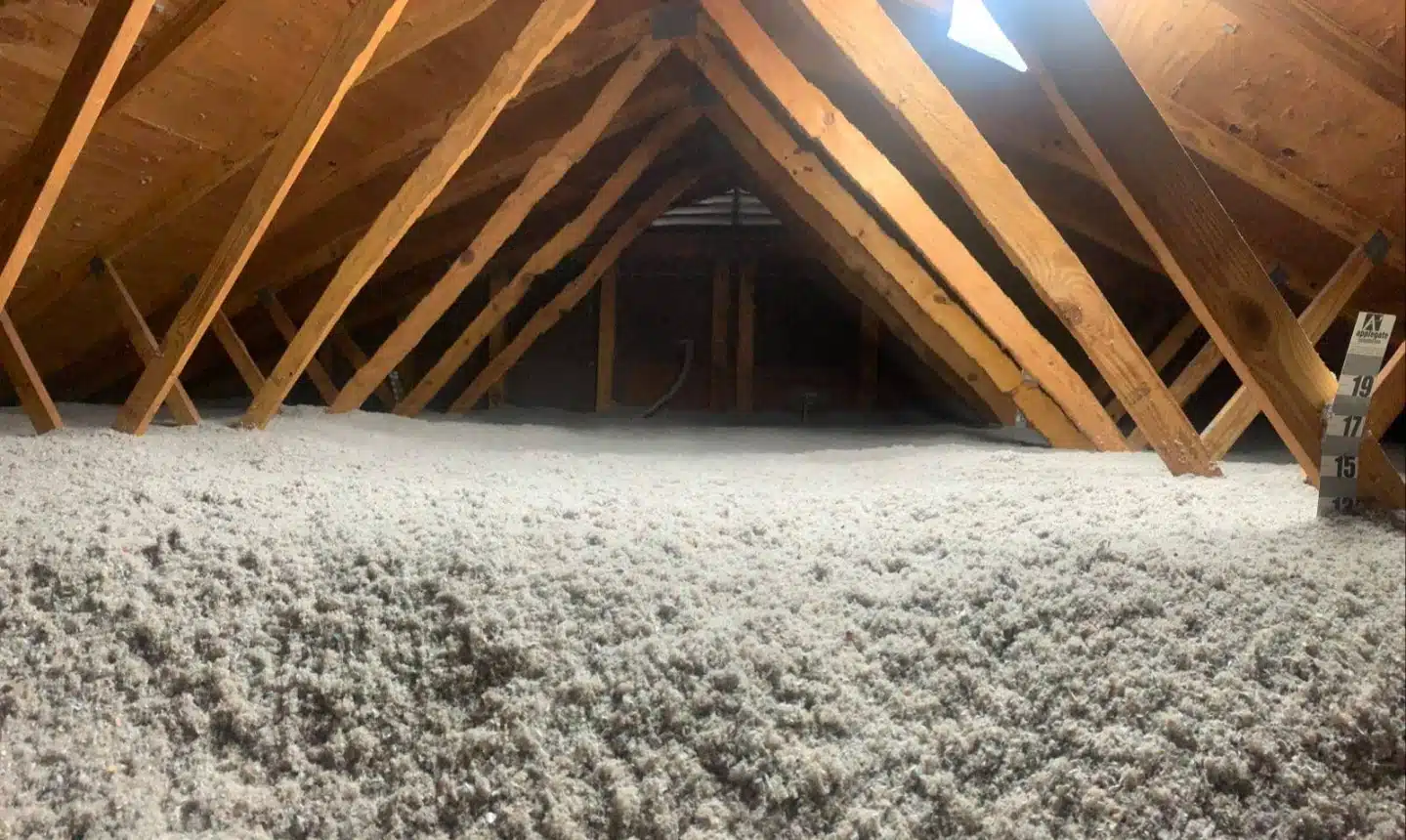
Vaulted ceilings give Atwater homes an open, spacious feel, but they also create one of the most challenging insulation scenarios in residential construction. Unlike standard flat attics with generous space for blown-in insulation, vaulted ceilings follow the roofline directly, leaving narrow rafter bays with limited room for thermal protection. In Atwater’s hot Central Valley summers and cool winter nights, that thin insulation gap becomes a serious problem for comfort and energy efficiency. Spray foam insulation addresses this challenge by combining high R-value per inch with an airtight seal, making it the most practical and effective choice for vaulted ceilings in our area.
TL;DR
- Vaulted ceilings leave narrow rafter cavities that traditional insulation cannot adequately fill or seal, leading to air leakage and thermal bridging
- Atwater, CA falls within California Energy Commission Climate Zone 3, requiring a minimum ceiling R-value of R-38 under the IECC prescriptive path
- Closed-cell spray foam delivers R-6 to R-7 per inch, allowing vaulted ceilings to meet or exceed code requirements within standard rafter depths
- Open-cell spray foam offers R-3.7 per inch at a lower density, providing air sealing and moisture permeability suited for specific applications
- Spray foam applied directly to the underside of roof sheathing creates an unvented assembly that works in all climate zones per building science research
- The airtight seal spray foam provides eliminates the air leakage pathways that fiberglass and cellulose simply cannot block
- Unvented foam assemblies improve wildfire resistance by eliminating soffit and ridge vent openings where embers can enter
The Structural Challenge of Vaulted Ceilings
Vaulted and cathedral ceilings follow the pitch of the roof, meaning there is no attic space between the living area and the roof deck. The insulation must fit entirely within the depth of the rafters, which are typically 2×6 (5.5 inches) or 2×8 (7.25 inches) framing members. This constraint alone eliminates many conventional insulation approaches.
Fiberglass batts rated for R-38, for example, require roughly 10 to 12 inches of depth. Even if you compress R-38 batts into a 5.5-inch cavity, the insulation loses effectiveness due to compression, and you still end up below the target R-value. Blown-in cellulose faces the same depth problem. Worse, neither of these materials creates an effective air barrier, so conditioned air from your living space leaks through gaps around the framing, wiring penetrations, and recessed light fixtures. These limitations are why many homeowners choose Attic Spray Foam Insulation.
According to the U.S. Department of Energy, foam-in-place insulation can fill even the smallest cavities and create an effective air barrier, yielding higher R-values than traditional batt insulation for the same thickness. This characteristic is precisely what makes spray foam suited for the tight rafter bays of vaulted ceilings.
Atwater’s Climate and Code Requirements
Atwater is located in Merced County, which the California Energy Commission places in Climate Zone 3. Under the IECC Compliance Guide for California homes, Climate Zone 3 requires a minimum ceiling insulation R-value of R-38, and walls require R-20 (or R-13 with R-5 insulated sheathing). In California’s hot summers, that ceiling insulation is your primary defense against radiant heat gain through the roof. During winter, it prevents warm indoor air from escaping.
The California Energy Commission maintains a climate zone mapping system with 16 distinct zones to account for the state’s varied climates. Local building departments and energy consultants use these zones to determine insulation, window, and HVAC requirements for every project. Knowing your zone tells you exactly what performance your insulation assembly needs to deliver.
Open-Cell vs. Closed-Cell Spray Foam for Vaulted Ceilings
Choosing the right spray foam formulation matters for vaulted ceiling performance and long-term durability. The two main options have distinct properties that affect how they function in a roof assembly.
| Property | Open-Cell Spray Foam | Closed-Cell Spray Foam |
|---|---|---|
| R-Value Per Inch | ~R-3.7 | ~R-6.0 to R-7.0 |
| Density | 0.5 lb/ft³ | 2.0 lb/ft³ |
| Air Barrier | Yes (fills all gaps) | Yes (fills all gaps) |
| Vapor Permeance | Vapor-permeable | Vapor retarder at 2+ inches |
| Moisture Resistance | Can absorb water | Negligible water absorption |
| Structural Benefit | Minimal | Adds rigidity to assembly |
| Best Application | Vented assemblies, deeper cavities | Unvented assemblies, limited depth |
For vaulted ceilings in Atwater, closed-cell spray foam is often the better choice for several reasons. First, the higher R-value per inch means you can achieve code-required insulation levels within standard rafter depths. A 5.5-inch cavity filled with closed-cell foam delivers approximately R-33 to R-38, meeting the IECC Climate Zone 3 requirement. Second, closed-cell foam acts as both an air barrier and a vapor retarder when installed at 2 inches or greater, which is critical for unvented roof assemblies and attic insulation projects.
Open-cell foam still has its place. It costs less per square foot, fills cavities completely for effective air sealing, and its vapor permeability allows the assembly to dry in both directions. For deeper rafter bays or vented cathedral ceiling designs, open-cell foam is a viable option.
Why Unvented Roof Assemblies Work
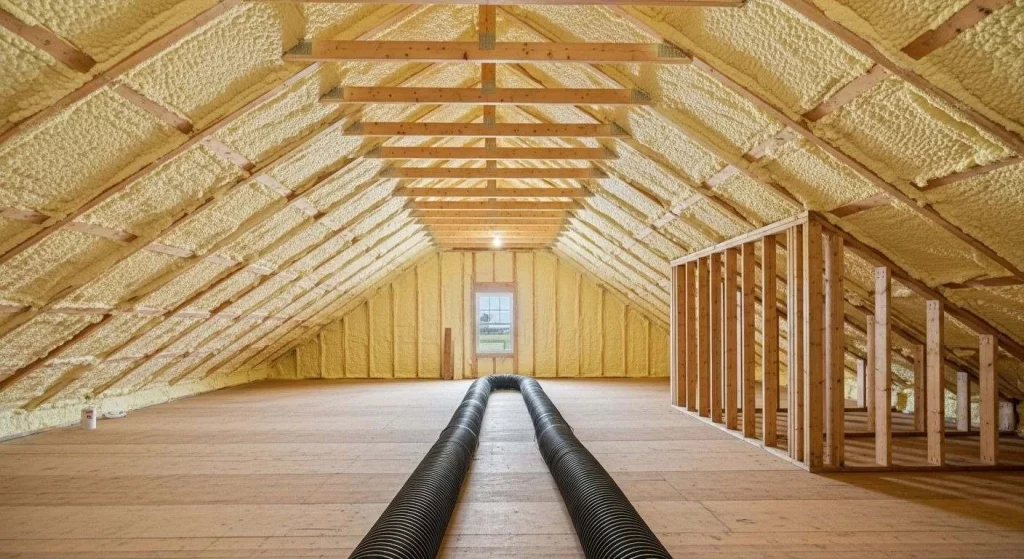
One of the biggest advantages of spray foam in vaulted ceilings is the ability to create an unvented roof assembly, sometimes called a “hot roof.” In this design, spray foam is applied directly to the underside of the roof deck, eliminating the need for soffit vents, ridge vents, or ventilation channels above the insulation.
Building Science Corporation’s research confirms that closed-cell spray polyurethane foam can be used to create an unvented roof assembly that works in all climate zones. The foam simultaneously controls airflow, heat flow, and vapor diffusion, eliminating the three primary failure modes in cathedral ceiling insulation. It prevents warm, humid indoor air from reaching the back of roof sheathing where condensation can form, while also providing secondary rainwater protection if the primary roofing underlayment leaks.
The DOE Building America Solution Center further supports this approach, noting that spray foam on the underside of the roof deck has been used successfully since the mid-1990s. Their guidance specifies that the spray foam should be applied in direct contact with the roof sheathing, with additional cavity insulation added as needed to meet or exceed local energy code requirements.
How Thermal Bridging Affects Vaulted Ceiling Performance
Thermal bridging through the wood rafters is a significant but often overlooked problem in vaulted ceiling assemblies. Wood has an R-value of only about R-1.4 per inch, meaning a 2×8 rafter spanning from interior to exterior creates a direct conductive path for heat. Even if the cavity insulation performs well, heat escapes (or enters) through the framing.
As Fine Homebuilding explains, what really matters is the whole-wall (or whole-ceiling) R-value, not just the insulation R-value. The same analysis applies to cathedral ceiling assemblies: thermal bridging through the rafters degrades overall performance. Spray foam helps mitigate this by expanding to fill the cavity completely and adhering to the framing, reducing air movement along the framing surfaces. For homeowners who want to push performance further, adding a continuous layer of rigid foam insulation below the rafters can substantially reduce thermal bridging across the entire ceiling plane.
Moisture Control in Atwater’s Climate
Moisture management is essential in any roof assembly, and vaulted ceilings are less forgiving than vented attics. In attic insulation projects in Atwater, CA, winter temperatures can drop below freezing at night while daytime highs reach the 50s and 60s, creating conditions where warm indoor air reaching cold roof sheathing can condense.
Closed-cell spray foam addresses this in two ways. It creates an airtight seal that prevents moist indoor air from reaching the sheathing, and its low vapor permeance slows diffusion to safe levels. As BuildingAdvisor notes, closed-cell polyurethane foam has an R-value of R-6 to R-7 per inch and is a very effective vapor retarder, making it the preferred choice for unvented cathedral ceilings where moisture control is critical.
One caution: with unvented assemblies, you should never install a Class I vapor barrier (such as polyethylene sheeting) on the interior side of the ceiling. The assembly needs to be able to dry inward if moisture ever gets into the roof cavity. A smart vapor retarder or standard drywall with latex paint provides sufficient interior protection while allowing some drying potential.
Choosing the Right Approach for Your Vaulted Ceiling
Not every vaulted ceiling project is the same. The best insulation strategy depends on your specific situation.
| Scenario | Recommended Approach | Why |
|---|---|---|
| Shallow 2×6 rafters, no ventilation possible | Closed-cell spray foam, full cavity fill | Meets R-value requirements in limited space, creates air and vapor barrier |
| Deep 2×10 or 2×12 rafters, simple roof geometry | Flash and fill: closed-cell against sheathing, open-cell or fiberglass below | Cost-effective, meets code, foam layer handles air sealing and vapor control |
| Existing vaulted ceiling, retrofit without removing drywall | Closed-cell foam injected from above (during re-roof) or dense-pack from below | Addresses air sealing where access is limited |
| Complex roof with multiple skylights and valleys | Closed-cell spray foam, unvented assembly | Vented approach is impractical; foam handles complex geometries |
| Exposure to wildfire risk | Closed-cell spray foam, unvented assembly | Eliminates vent openings where embers can enter attic spaces |
Signs You’ve Found the Right Insulation Installer
Choosing a qualified spray foam installer is just as important as selecting the right material. Here are the indicators that separate experienced professionals from the rest:
- Detailed assessment before quoting: A reputable installer will ask about your rafter depths, roof ventilation setup, and existing ceiling finishes before recommending a foam type and thickness
- Clear explanation of open-cell vs. closed-cell tradeoffs: The right contractor explains why one formulation better suits your specific vaulted ceiling assembly rather than pushing a single product
- Knowledge of local code requirements: They understand California Title 24 and IECC Climate Zone 3 requirements and can show how their recommended installation meets or exceeds them
- Commitment to substrate preparation: Spray foam adheres best to clean, dry surfaces, and the installer should confirm the roof sheathing and framing are properly prepared before application
- Willingness to discuss moisture control: A thorough installer addresses vapor management, ventilation strategy, and drying potential rather than just R-value
Get Your Vaulted Ceiling Insulation Right
Supreme Spray Foam Fresno brings experienced, certified spray foam installation to Atwater and the surrounding Central Valley region. Our team evaluates every vaulted ceiling project individually, assessing rafter depths, roof geometry, and existing conditions to recommend the right foam type and application thickness for maximum comfort and energy efficiency. We handle both new construction and retrofit installations, and we work within California Title 24 requirements so your project stays compliant from day one.
Call us at (559) 545-0800 or email [email protected] to discuss your project. We are ready to help you make the most informed decision for your home.
Frequently Asked Questions
Can spray foam be installed in my existing vaulted ceiling without removing the drywall?
In most cases, closed-cell spray foam must be applied from above, which typically requires removing the roof sheathing. Some retrofit applications can inject foam through small access holes, but full-cavity coverage is harder to verify without direct visual access.
Is closed-cell spray foam worth the added cost for a vaulted ceiling in Atwater?
For vaulted ceilings with standard rafter depths, closed-cell foam is often the only way to achieve the R-38 minimum required in Climate Zone 3. The air sealing benefit alone can significantly reduce HVAC runtime in Atwater’s climate.
Will spray foam make my vaulted ceiling too airtight?
Properly installed spray foam creates a tight building envelope, which is the goal. Your home should still have controlled mechanical ventilation to maintain indoor air quality, whether or not spray foam is present.
How long does spray foam insulation last in a vaulted ceiling?
Spray foam insulation, when properly installed, is designed to last the life of the building. It does not settle, sag, or degrade over time like fiberglass or cellulose can.
Does my vaulted ceiling need ventilation if I use spray foam?
With closed-cell spray foam applied directly to the roof deck, ventilation is not required or recommended. The foam replaces ventilation by controlling air, heat, and moisture at the roof plane. With open-cell foam, the design approach may differ depending on your specific climate and assembly.
Sources
- U.S. Department of Energy – Types of Insulation – Federal guide covering all insulation types including spray foam properties, installation methods, R-values, and air barrier capabilities for residential buildings.
- Building Science Corporation – Unvented Roof Assemblies for All Climates – Technical digest documenting how closed-cell spray polyurethane foam creates effective unvented roof assemblies across all climate zones, with guidance on air, heat, moisture, and rainwater control.
- DOE Building America Solution Center – Unvented Conditioned Attic with Spray Foam – DOE-funded resource providing installation guidance, code compliance references, and moisture management strategies for spray foam under roof decking in cathedral ceilings and conditioned attics.
- California Energy Commission – Climate Zone Tool and Maps – Official state resource defining California’s 16 building climate zones used to set insulation, fenestration, and HVAC efficiency requirements under Title 24.
- Insulation Institute – IECC Compliance Guide for California Homes – Code compliance reference mapping California counties to IECC climate zones with prescriptive R-value tables for ceilings, walls, floors, and foundations.
- BuildingAdvisor – Spray Foam for Cathedral Ceilings – Building science Q&A addressing closed-cell vs. open-cell spray foam selection, moisture risks, ventilation strategies, and installation best practices for unvented vaulted and cathedral ceiling assemblies.