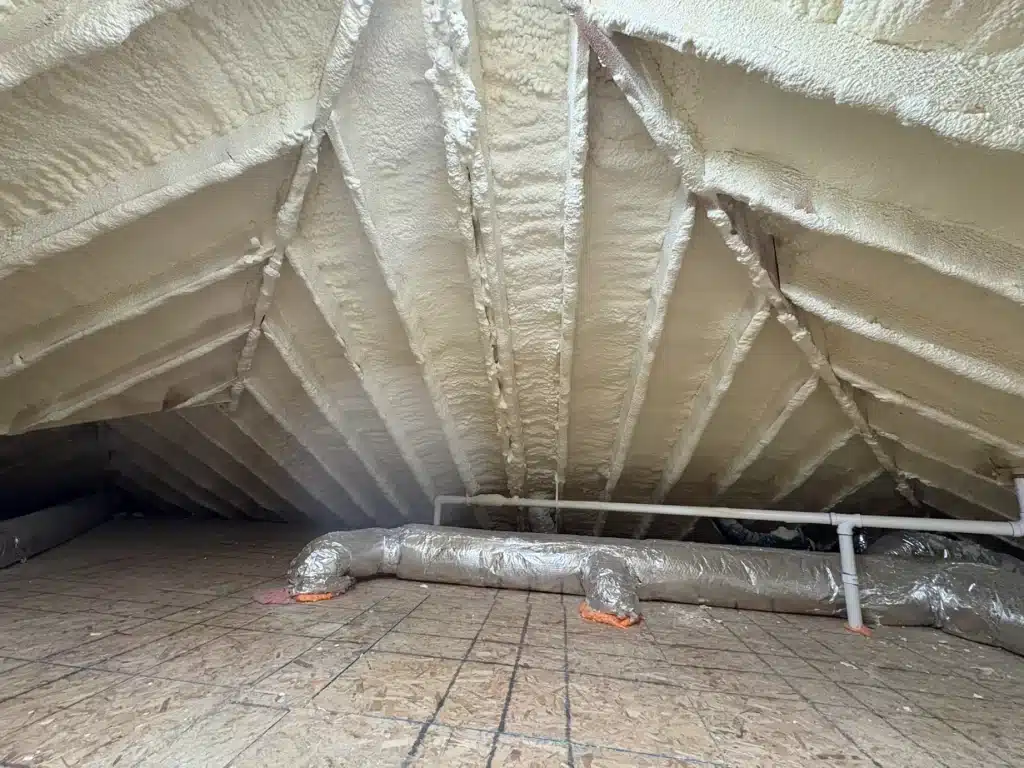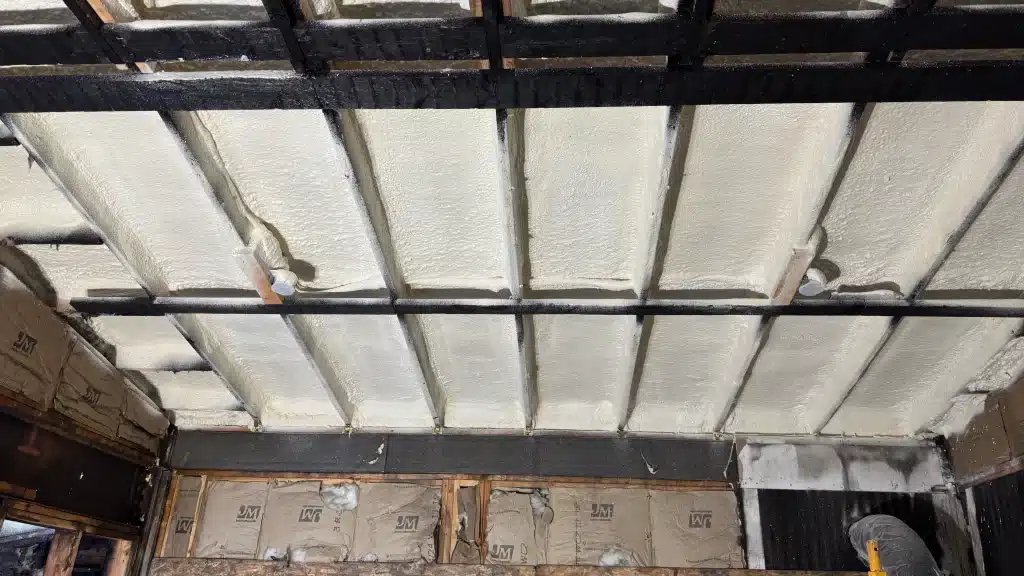

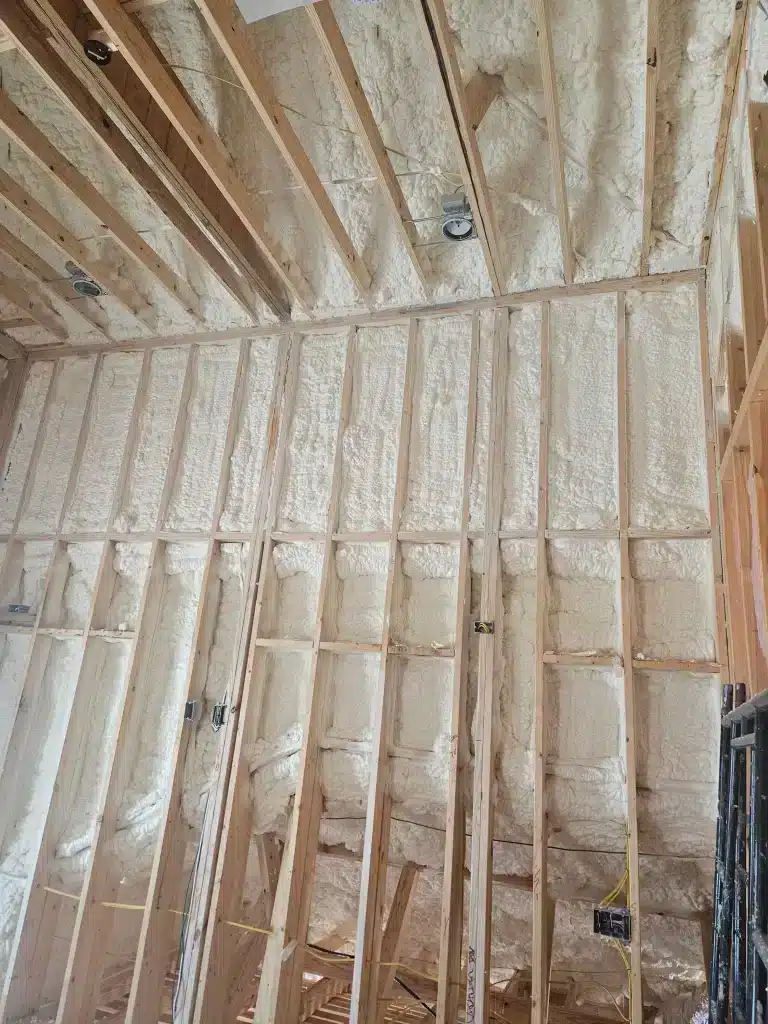
Neither open-cell nor closed-cell spray foam is universally better. Closed-cell spray foam delivers roughly double the R-value per inch, acts as a vapor barrier, and adds structural rigidity, making it the better choice for tight spaces, cold climates, and moisture-prone areas. Open-cell spray foam costs significantly less per square foot, expands up to three times more to fill irregular cavities, and provides superior sound dampening, making it the practical choice for large open wall cavities, interior partitions, and budget-conscious projects where space allows for thicker application. The right pick comes down to your project’s climate zone, available cavity depth, moisture exposure, and budget.
TLDR / Key Takeaways
- Closed-cell spray foam delivers R-6 to R-6.5 per inch versus R-3.5 to R-3.7 per inch for open-cell, according to the U.S. Department of Energy’s Building America program
- Closed-cell foam costs roughly twice as much per board foot as open-cell, typically ranging from $1.00 to $2.00 per board foot installed, compared to $0.40 to $0.80 for open-cell
- Closed-cell foam acts as both an air barrier and a vapor retarder; open-cell is an effective air barrier but remains vapor permeable
- Open-cell expands significantly more during application, making it better suited for filling irregular cavities and hard-to-reach voids
- Closed-cell adds structural strength to walls and roof decks at roughly 2.0 lb/ft³ density versus 0.5 lb/ft³ for open-cell
- In cold climates, closed-cell is strongly preferred for condensation control, as noted by Building Science Corporation
- Open-cell absorbs more sound, making it the stronger option for interior walls and shared partitions in multi-family or office construction
What Makes Open-Cell and Closed-Cell Fundamentally Different
Both products start as a two-part chemical mixture sprayed on-site, but the way they cure creates two very different materials. The key difference lies in the cell structure of the cured foam.
Open-cell spray foam is a low-density material at approximately 0.5 lb/ft³. As it cures, the cells burst open, leaving tiny air pockets throughout the material. This gives it a soft, spongy texture similar to a foam cushion. The open structure means air and moisture can pass through slowly, which makes it vapor permeable. It expands aggressively during application, often tripling in volume, which helps it fill every crack and gap in wall cavities.
Closed-cell spray foam is a high-density material at roughly 2.0 lb/ft³. The cells remain sealed during curing, trapping the blowing agent gas inside. This creates a rigid, hard material that feels almost like solid plastic. The closed-cell structure prevents both air and moisture from passing through, giving it built-in vapor barrier properties. It expands less than open-cell but packs much more insulation power into a thinner layer.
Johns Manville confirms that these structural differences directly drive the performance gap in thermal resistance, acoustic properties, and moisture management between the two types. The Spray Polyurethane Foam Alliance (SPFA), the industry’s leading technical and educational body, further classifies these two foam types into distinct categories (SPFA Type I for open-cell and SPFA Type II for closed-cell) based on their density, cell structure, and intended application performance criteria.
Head-to-Head Performance Comparison
| Factor | Open-Cell | Closed-Cell |
|---|---|---|
| R-Value per Inch | R-3.5 to R-3.7 | R-6.0 to R-6.5 |
| Density | ~0.5 lb/ft³ | ~2.0 lb/ft³ |
| Vapor Permeability | Vapor permeable (1-5 perms) | Vapor impermeable (<1 perm) |
| Air Barrier | Yes | Yes |
| Expansion Rate | Very high (up to 100x) | Moderate (up to 30-40x) |
| Sound Dampening | Excellent | Moderate |
| Structural Reinforcement | None | Adds wall and roof rigidity |
| Installed Cost (per board foot) | $0.40 to $0.80 | $1.00 to $2.00 |
| Best Cavity Depth | 5.5 inches or more | 2 to 3 inches |
Where Closed-Cell Spray Foam Wins
Closed-cell foam is the go-to choice when you need maximum thermal performance in a limited space. A 2-inch layer of closed-cell can match or exceed what a full 3.5 inches of open-cell achieves in R-value. This matters in retrofit projects where wall cavity depth is already restricted by existing framing.
It also serves as a vapor retarder without requiring an additional membrane. In climates with cold winters, this prevents warm indoor air from condensing inside wall assemblies, which can lead to mold, rot, and structural damage. Building Science Corporation’s residential spray foam guide specifically recommends high-density closed-cell foam in cold climates for this condensation control benefit.
The rigidity of closed-cell foam also adds measurable structural strength to walls and roof assemblies. Research from Oak Ridge National Laboratory (ORNL), a U.S. Department of Energy national lab focused on building science, has demonstrated that closed-cell spray foam can significantly increase the racking strength and shear resistance of wall assemblies when applied to framing cavities. For metal buildings, pole barns, and commercial roof decks, this added stiffness is a meaningful advantage.
Closed-cell is the better choice for crawl spaces, basements, rim joists, and anywhere that foam will be exposed to moisture or direct contact with the ground. Its impermeable nature prevents water intrusion from penetrating into the building envelope.
Where Open-Cell Spray Foam Wins
Open-cell foam dominates in cost-sensitive projects covering large areas. When you need to insulate thousands of square feet of open wall cavity, open-cell delivers strong air sealing and thermal performance at roughly half the material cost of closed-cell. For new construction where cavity depth is not a constraint, this cost advantage compounds quickly across an entire home or commercial building.
The sound absorption qualities of open-cell are significantly better than those of closed-cell. The soft, open-cell structure absorbs sound waves rather than reflecting them. This makes it a popular choice for interior partition walls, home theaters, recording studios, and multi-family construction where sound transmission between units is a concern.
Open-cell is also more forgiving during installation. Its higher expansion rate means it fills irregular voids around electrical wiring, plumbing runs, and odd-shaped framing more completely. It adheres well to wood, concrete, and metal substrates without the risk of over-compressing or creating voids.
For attics, especially in warmer climates, open-cell applied to the roof deck creates an effective conditioned attic assembly. Since it is vapor-permeable, it allows any incidental moisture in the roof assembly to dry toward the interior, reducing the risk of trapped moisture problems.
Bar Chart Suggestion: Side-by-side bar chart comparing R-value per inch between open-cell (3.6) and closed-cell (6.5), with an additional bar showing cost per board foot for each type. This visual makes the tradeoff between performance and price immediately clear.
Cost Breakdown: What Contractors Actually Pay
Material cost is where the two products diverge most sharply. Closed-cell foam requires more raw material per cubic foot because of its higher density and the cost of the blowing agents used. Open-cell uses water as a primary blowing agent, which is far less expensive.
According to the U.S. Environmental Protection Agency (EPA), selecting the right insulation type is one of the most cost-effective ways to improve a home’s energy efficiency, with proper insulation potentially reducing heating and cooling costs by an average of 15% or more. These long-term energy savings can help offset the higher upfront material cost of spray foam, particularly closed-cell, over the life of the building.
| Project Scope | Open-Cell (Installed) | Closed-Cell (Installed) |
|---|---|---|
| 1,000 sq ft walls (2×4 framing) | $800 to $1,200 | $1,500 to $2,500 |
| 1,000 sq ft walls (2×6 framing) | $1,000 to $1,500 | $1,800 to $3,000 |
| 1,000 sq ft roof deck | $900 to $1,400 | $1,600 to $2,800 |
| Rim joist (typical home) | $200 to $400 | $400 to $700 |
| Full home (2,000 sq ft) | $3,500 to $6,000 | $7,000 to $14,000 |
These are general estimates. Actual pricing varies by region, contractor, foam manufacturer, and project complexity. Labor costs tend to be similar for both types, so the material price difference drives most of the total gap.
Line Graph Suggestion: A line graph plotting cumulative insulation cost on the Y-axis against total square footage on the X-axis, with two lines representing open-cell and closed-cell. The diverging gap as square footage increases effectively illustrates how the cost difference compounds on larger projects.

Real-World Scenarios: Which Foam for Which Job
| Scenario | Property Type | Recommended Option | Estimated Cost |
|---|---|---|---|
| New construction, 2×6 walls, mixed climate | Single-family residence | Open-cell | $4,500 to $6,500 |
| Retrofit basement rim joist, cold climate | Existing home | Closed-cell | $800 to $1,200 |
| Metal building shop insulation | Commercial workshop | Closed-cell | $5,000 to $9,000 |
| Townhome interior partition walls | Multi-family housing | Open-cell | $2,000 to $3,500 |
| Unvented cathedral ceiling, cold climate | Custom home | Closed-cell | $3,000 to $5,000 |
| Conditioned attic, warm climate | New construction home | Open-cell | $2,500 to $4,000 |
Factors That Influence the Decision
Several project-specific variables determine which foam type delivers the best return:
- Climate zone: Cold climates favor closed-cell for vapor control. Hot climates can use open-cell more freely, especially in vented assemblies.
- Available cavity depth: Thin framing (2×4 or less) limits how much open-cell you can install, making closed-cell the only way to hit high R-values in shallow cavities.
- Moisture exposure: Below-grade applications, crawl spaces, and coastal environments call for closed-cell’s impermeable barrier.
- Budget constraints: Open-cell cuts material costs roughly in half for comparable coverage areas.
- Sound control requirements: Multi-family, office, and hospitality projects benefit from open-cell’s acoustic properties.
- Structural needs: Roof decks, metal buildings, and hurricane-prone zones benefit from closed-cell’s added rigidity.
- Building code requirements: Some jurisdictions require specific vapor barrier performance that only closed-cell can meet in certain assemblies. The International Code Council (ICC), which develops the model building codes adopted across most U.S. jurisdictions, includes specific provisions for spray foam insulation regarding vapor retarder class, air barrier requirements, and minimum R-values by climate zone that directly influence which foam type is code-compliant for a given project.
Who Open-Cell Spray Foam Is For (And Is Not)
Ideal for open-cell:
- New construction projects with standard or deep wall cavities (2×6 or deeper)
- Interior partition walls in multi-family, office, or hospitality buildings
- Homeowners and builders working with tighter insulation budgets
- Attic floor or roof deck applications in warm, dry climates
- Projects where sound attenuation is a priority
Not ideal for open-cell:
- Below-grade walls, basements, or crawl spaces with moisture exposure
- Thin-wall cavities, where achieving the target R-value requires more depth than available
- Cold climate projects where vapor drive creates condensation risk
- Metal buildings or pole barns where structural rigidity is needed
Who Closed-Cell Spray Foam Is For (And Is Not)
Ideal for closed-cell:
- Retrofit and renovation projects with shallow framing depths
- Cold climate construction where condensation control is non-negotiable
- Crawl spaces, basements, and rim joists with ground or moisture contact
- Metal building insulation and commercial roof deck applications
- Projects requiring both insulation and structural reinforcement
Not ideal for closed-cell:
- Large-scale new construction where the budget is the primary driver
- Interior walls where sound-dampening matters more than thermal resistance
- Projects where vapor permeability is desired to allow assembly drying
- Areas where code officials have flagged closed-cell for off-gassing in occupied spaces during cure
Get a Professional Insulation Assessment for Your Project
Choosing between open-cell and closed-cell spray foam depends on your specific building, climate, and budget. At Supreme Spray Foam Fresno, we evaluate every project individually to recommend the foam type that delivers the best performance and value for your situation. Whether you are insulating a new build, retrofitting an older home, or working on a commercial property, our team has the experience to get it right.
Call us directly at (559) 545-0800 or email [email protected]. We serve Fresno and the surrounding Central Valley area with professional spray foam insulation installation.
Sources
- U.S. Department of Energy — Building America Spray Foam Insulation Guide — Performance data on R-values, thermal resistance, and best-practice recommendations for residential spray foam insulation.
- Building Science Corporation — Residential Spray Foam Guide — Expert guidance on condensation control, climate-specific recommendations, and vapor barrier considerations for open-cell and closed-cell spray foam.
- Oak Ridge National Laboratory (ORNL) — U.S. Department of Energy national laboratory research on building envelope performance, structural reinforcement properties of closed-cell spray foam, and energy efficiency in insulation systems.
FAQs
Can you spray open-cell and closed-cell on the same project?
Yes, and it is actually a common strategy. Many contractors use closed-cell in moisture-critical areas like rim joists, crawl spaces, and basements, then switch to open-cell for large wall cavities and interior partitions. This approach maximizes performance where it matters most while keeping overall project costs in check.
Does closed-cell spray foam need a separate vapor barrier?
No. Closed-cell spray foam at 1.5 inches or thicker meets the requirements of a Class II vapor retarder on its own. You do not need to install an additional polyethylene sheet or vapor barrier membrane over it in most standard wall and roof assemblies.
Is open-cell spray foam waterproof?
No. Open-cell foam is vapor-permeable and will absorb and hold water if exposed to direct moisture. It should never be used in applications where it will have direct contact with water, such as below-grade basement walls or exterior foundation surfaces. Closed-cell is the appropriate choice for those conditions.
How long does spray foam insulation last?
Both open-cell and closed-cell spray foam are considered permanent insulation materials. When properly installed, they do not settle, sag, or degrade over time. Both types carry manufacturer warranties of 30 years or more, and in practice, they can last the lifetime of the building without any loss in performance.
Can spray foam be installed over existing insulation?
In most cases, existing insulation should be removed before spray foam application. Spray foam needs a clean, dry substrate to adhere properly. Installing over old fiberglass or cellulose can create air gaps, reduce bond strength, and trap moisture between layers. There are some exceptions for specific assembly types, but removal is the standard best practice.