
Fresno’s summer heat is no joke. When temperatures regularly push past 100 degrees from June through September, commercial buildings without proper insulation become money pits. Your HVAC system works overtime, your energy bills climb, and your tenants or employees deal with uncomfortable indoor temperatures that hurt productivity and satisfaction.
The fix is straightforward but requires real planning. Commercial insulation is not something you can approach casually. The wrong material, a sloppy installation, or a missed air gap can undermine the entire project. This guide walks you through every stage of the process, from figuring out what your building actually needs to verifying that the final installation meets the mark.
What you will find here is based on years of hands-on work insulating commercial buildings across Fresno and the Central Valley. Supreme Spray Foam Fresno has seen what works, what fails, and what separates a quality insulation job from one that causes problems down the road. Consider this guide your reference manual for making smart, informed decisions about commercial insulation.
Why Commercial Insulation Matters in Fresno’s Climate
Fresno sits in California’s Central Valley, a region known for extreme summer heat and cool, sometimes foggy winters. According to data from the U.S. Department of Energy, adding proper insulation to a building can reduce heating and cooling costs by an average of 15 to 20 percent. In a climate like Fresno’s, where air conditioning drives the bulk of your energy consumption for roughly half the year, those savings add up fast.
Think about what happens inside an uninsulated or poorly insulated commercial building during a Fresno summer. The sun beats down on the roof, and that heat transfers directly into the building through conduction. Walls without adequate insulation let outdoor temperatures seep in. Your cooling system has to compensate for that constant heat gain, running longer and harder than it should. The result is higher electricity bills, more wear on HVAC equipment, and inconsistent temperatures from one side of the building to the other.
The winter side of the equation matters too. Fresno winters are mild compared to much of the country, but temperatures do drop into the 30s at night, and the persistent valley fog can create damp, chilly conditions. Without proper insulation, heat escapes through the roof and walls, and your heating system has to work to maintain comfortable indoor temperatures during business hours.
Beyond energy costs, insulation plays a direct role in moisture control. In a region where summer humidity can spike and winter brings damp fog, condensation inside wall cavities and roof assemblies is a real threat. Good insulation paired with proper air sealing keeps moisture from accumulating where it can cause mold, rot, and structural damage.
Key Takeaways:
- Fresno’s extreme summer heat makes insulation a direct money-saver on cooling costs
- Poor insulation forces HVAC systems to work harder, shortening equipment lifespan
- Insulation also controls moisture, protecting your building from mold and structural damage
- The Central Valley’s winter fog and cool nights mean heating savings matter too
Understanding the Main Types of Commercial Insulation
Not all insulation does the same job, and picking the right type for your commercial building depends on several factors including your building type, budget, existing construction, and performance goals. Here is a breakdown of the four materials you will encounter most often in commercial projects.
Spray Foam Insulation
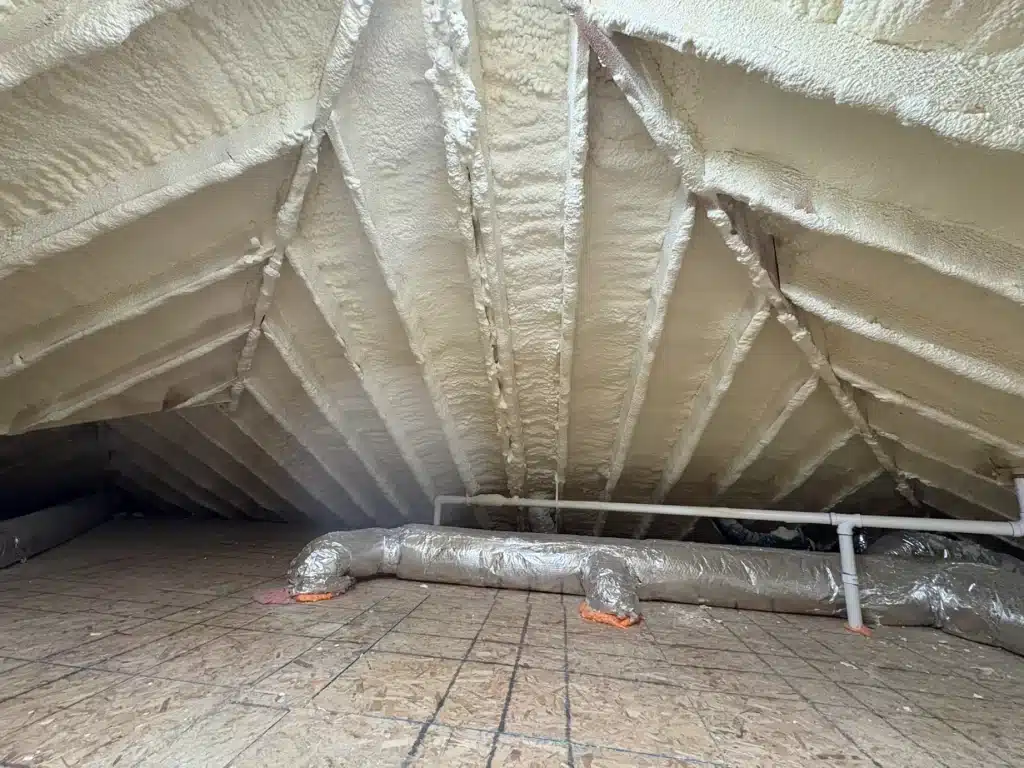
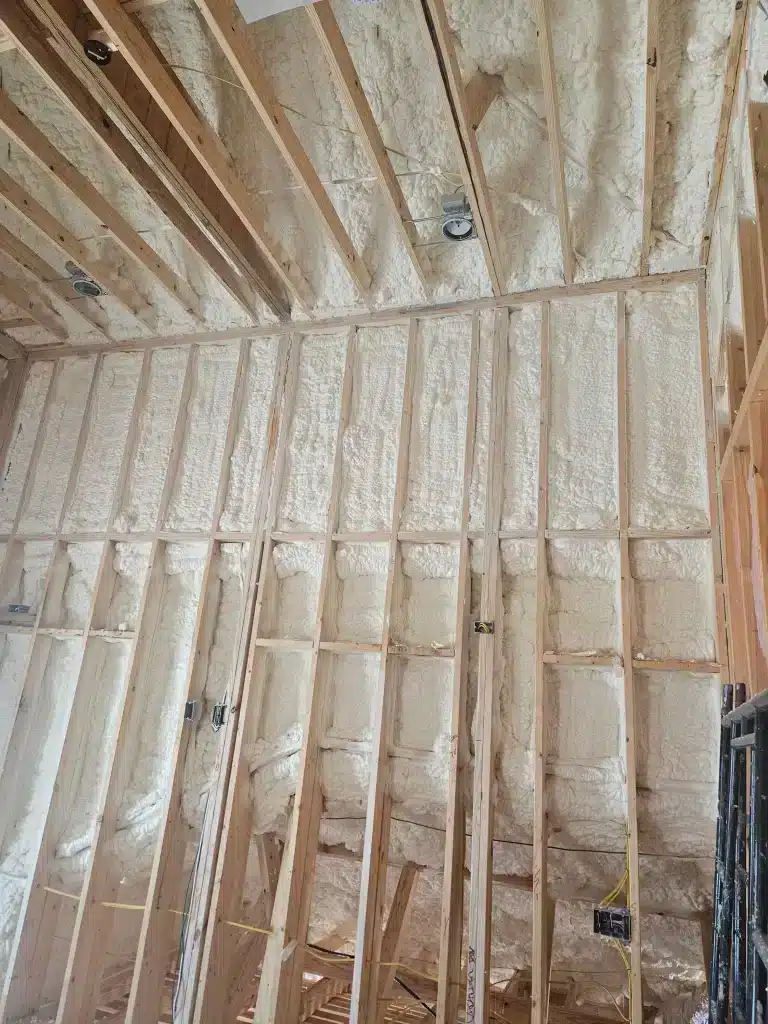
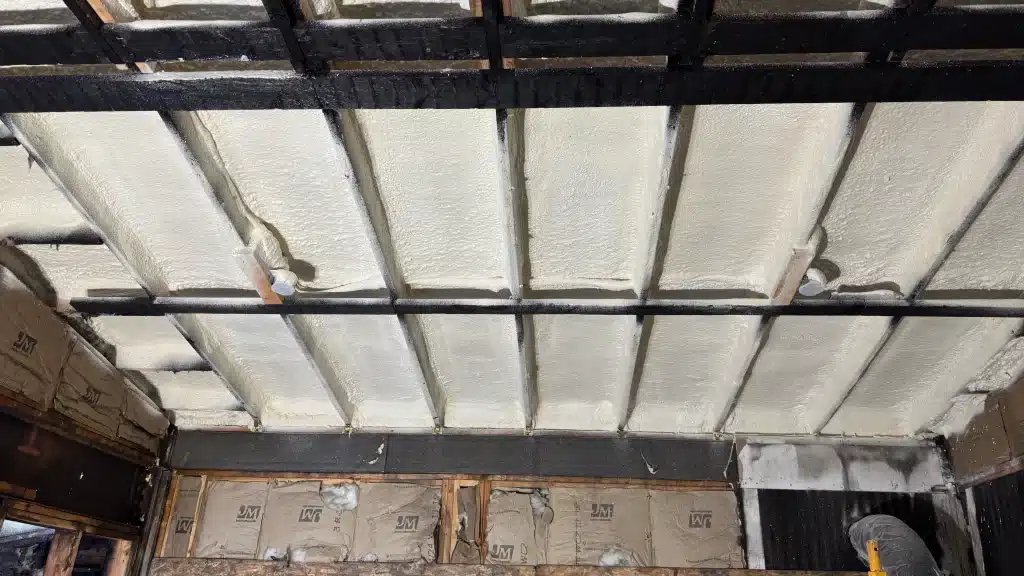
Spray foam comes in two varieties: open-cell and closed-cell. Open-cell spray foam is lighter, less expensive, and has an R-value of about 3.5 to 3.7 per inch. It expands significantly when applied, filling gaps and crevices effectively, but it does not provide a meaningful moisture barrier. Closed-cell spray foam is denser, with an R-value of 6.0 to 7.0 per inch. It acts as both an insulator and a vapor barrier, and it adds structural rigidity to the assembly.
In commercial settings, closed-cell spray foam is often the go-to choice for metal buildings, roof decks, and any area where moisture control is critical. Open-cell works well in interior wall cavities where cost is a bigger concern than vapor resistance. [Link to: Detailed Guide on Spray Foam vs Fiberglass for Commercial Buildings]
Fiberglass Batts and Blankets
Fiberglass is the most familiar insulation material and remains widely used in commercial construction. Pre-cut batts fit between wall studs and ceiling joists, while blankets come in continuous rolls. Fiberglass has an R-value of roughly 2.9 to 3.8 per inch depending on the density. It is inexpensive and easy to install in standard framing, but it does not seal air gaps on its own. Any voids, compression, or gaps around obstacles significantly reduce its effective performance.
For commercial buildings with standard wood or metal stud framing, fiberglass batts can be a cost-effective option when paired with a separate air sealing step. It is less suitable for irregular spaces, curved surfaces, or areas where moisture is a concern.
Rigid Foam Boards
Rigid foam insulation comes in three main types: expanded polystyrene (EPS), extruded polystyrene (XPS), and polyisocyanurate (polyiso). R-values range from about 3.8 per inch for EPS up to 6.5 per inch for polyiso. Rigid foam boards are commonly used in commercial roof assemblies, exterior continuous insulation, and below-grade applications like foundation walls.
The big advantage of rigid foam is its dimensional stability and moisture resistance. It provides a continuous layer of insulation without the gaps and compression issues that plague fiberglass batts. The downside is that seams between boards need to be sealed, and the material does not conform to irregular shapes.
Blown-In Cellulose
Cellulose insulation is made from recycled paper treated with fire retardants. It is blown into wall cavities and attic spaces using specialized equipment, with an R-value of about 3.1 to 3.8 per inch. Cellulose fills gaps and voids better than fiberglass batts, but it can settle over time, reducing its effective R-value in wall cavities.
In commercial applications, cellulose is most often used in retrofit projects where existing walls are closed, and the insulation needs to be blown in through small holes. It is also common in attic floors of older commercial buildings.
| Material | R-Value Per Inch | Best Commercial Applications | Air Sealing | Moisture Barrier |
|---|---|---|---|---|
| Closed-Cell Spray Foam | 6.0 – 7.0 | Metal buildings, roof decks, crawl spaces | Excellent | Yes |
| Open-Cell Spray Foam | 3.5 – 3.7 | Interior wall cavities, sound control | Good | No |
| Fiberglass Batts | 2.9 – 3.8 | Standard stud walls, ceiling joists | Poor | No |
| Rigid Foam Boards | 3.8 – 6.5 | Roof assemblies, continuous exterior insulation | Moderate | Varies by type |
| Blown-In Cellulose | 3.1 – 3.8 | Retrofit wall cavities, attic floors | Moderate | No |
Expert Tip: Do not get fixated on R-value alone. A high-R-value insulation installed poorly will underperform a lower-R-value material installed with meticulous air sealing. The real-world performance depends on how well the entire assembly prevents air movement and heat transfer, not just the rated R-value of the material.
Step 1: Assessing Your Building’s Insulation Needs
Before any material gets selected or any equipment arrives on site, you need a clear picture of what your building actually needs. Skipping this step is the most common mistake in commercial insulation projects.
Start with an Energy Audit
A professional energy audit identifies exactly where your building is losing energy. The auditor uses tools like infrared thermography to spot temperature differences that indicate missing or inadequate insulation, blower door tests to measure air leakage rates, and a review of your utility bills to establish baseline energy consumption. This data tells you where insulation upgrades will have the biggest impact.
If a full energy audit is outside your budget, a focused inspection still beats guessing. Walk through the building with a flashlight and look for visible gaps in insulation, particularly around penetrations like pipes, ducts, and electrical conduits. Check attics and mechanical rooms where insulation is often incomplete. Note any areas where you feel temperature differences on walls or ceilings.
Understand Fresno’s R-Value Requirements
California’s Title 24 energy standards set minimum insulation requirements based on climate zone and building type. Fresno falls within a climate zone that demands meaningful insulation performance, particularly for roofs and walls. The specific R-values required depend on whether you are doing new construction, a major renovation, or a smaller upgrade, and whether the building is conditioned or semi-conditioned space.
Keep in mind that code minimums are exactly that, minimums. For commercial buildings where you want to maximize energy efficiency and indoor comfort, exceeding code minimums often makes financial sense, especially when the incremental cost of additional insulation is modest compared to the long-term savings.
Expert Tip: Pay special attention to thermal bridging in commercial buildings. Steel studs, concrete slabs that extend through the wall assembly, and structural framing members all create paths for heat to bypass your insulation. An assessment that only looks at cavity insulation without accounting for thermal bridges will overestimate your building’s actual thermal performance.
Step 2: Choosing the Right Insulation Material
With your assessment complete, you can match the right material to each part of your building. This is not a one-size-fits-all decision. Most commercial buildings end up using a combination of materials.
Match Material to Location
Your roof assembly might call for rigid foam or spray foam, while your interior walls get fiberglass batts, and a retrofit wall cavity gets blown-in cellulose. The key is matching each material’s strengths to the demands of each location.
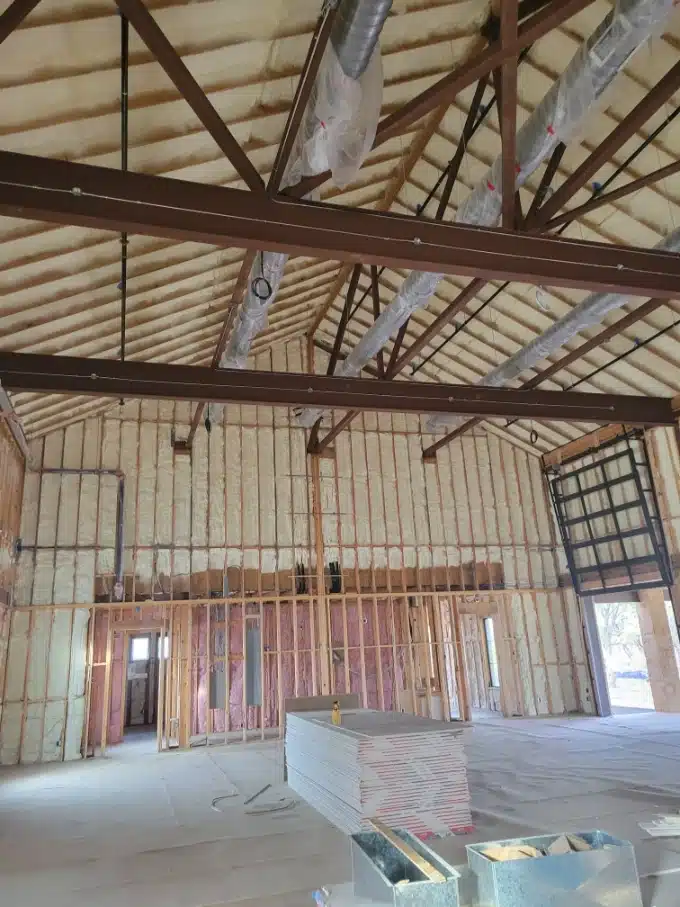
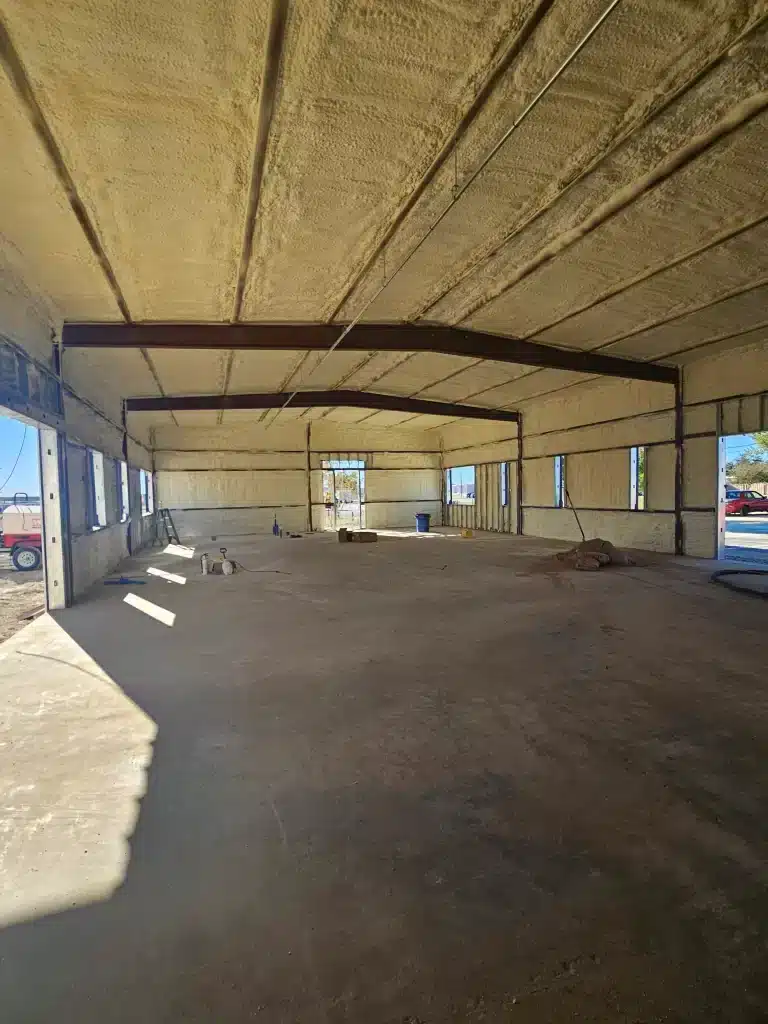
For metal building roofs in Fresno, closed-cell spray foam applied directly to the underside of the metal roof deck is hard to beat. It provides a high R-value, seals all the fasteners and overlaps in the metal, and eliminates condensation that would otherwise drip from the roof in summer. For a tilt-up concrete warehouse, continuous rigid foam on the exterior wall might be more practical and cost-effective than trying to insulate the interior.
Factor in Building Use and Occupancy
A cold storage facility has radically different insulation requirements than a standard office building. A restaurant kitchen generates heat and moisture that changes the insulation equation compared to the dining area. A data center needs consistent temperatures around the clock, making insulation and air sealing critical to both energy costs and equipment reliability.
Think about how each space in your building is used, what the internal heat loads are, and what temperature and humidity levels you need to maintain. That information should drive your material choices more than any general recommendation.
Step 3: Preparing the Site
Good installation starts long before the insulation truck pulls up. Site preparation has a direct impact on the quality of the finished job, and cutting corners here shows up later as air gaps, moisture problems, or code violations.
Clear the Work Areas
All surfaces that will receive insulation need to be clean, dry, and accessible. For spray foam applications, this means removing dust, debris, and any loose material from the substrate. For fiberglass or rigid foam installation, framing cavities need to be free of obstructions like leftover construction materials, wiring that was not properly routed, or plumbing that was not secured.
Seal Major Air Leaks First
Insulation works best when air movement through the building envelope is minimized. Before insulating, seal penetrations around pipes, ducts, electrical conduits, and structural elements with appropriate sealants. This is especially important in commercial buildings, which tend to have more and larger penetrations than residential construction.
Address Moisture Issues
If your assessment revealed any moisture problems, whether from roof leaks, plumbing issues, or condensation, those need to be fixed before insulation goes in. Adding insulation to a damp cavity traps moisture and creates conditions for mold growth. This is non-negotiable. [Link to: Detailed Guide on Air Sealing Best Practices for Commercial Buildings]
Expert Tip: Document everything before insulation goes in. Take photos of wall cavities, roof decks, and problem areas. This documentation is invaluable if questions come up later about what was behind the insulation, and it protects you if any pre-existing conditions are discovered during the project.
Step 4: The Installation Process
This is where the plan becomes reality. The installation process varies significantly depending on the material you have chosen, but there are common elements across all commercial insulation projects.
Spray Foam Installation
For spray foam, trained technicians wearing proper protective equipment apply the material using specialized rigs that mix and heat two chemical components before spraying them through a hose. The foam expands on contact, filling gaps and adhering to the substrate.
The application requires careful attention to thickness. Technicians use depth gauges to ensure the foam reaches the specified thickness for the target R-value. In commercial projects, this often means multiple passes, allowing each layer to partially cure before the next is applied. The foam must also be applied at the correct temperature and humidity conditions, which in Fresno’s summer heat sometimes means adjusting the chemical formulation or scheduling work during cooler parts of the day.
Fiberglass Installation
Fiberglass batt installation seems straightforward, but it is easy to get wrong. Batts must be friction-fit into cavities without compression, which reduces R-value. They need to be cut carefully around obstacles rather than stuffed or folded. Facing kraft-faced batts must be installed on the correct side (the warm-in-winter side in most Fresno applications) and must not create a double vapor barrier when combined with other building materials.
Quality Checkpoints During Installation
Regardless of material, quality verification should happen throughout the installation, not just at the end. Check for:
- Complete coverage with no gaps or voids
- Correct material thickness or density
- Proper fit around obstacles and penetrations
- Correct vapor barrier orientation where applicable
- No damage to surrounding building components
Expert Tip: If you are installing spray foam, ask the installer about the chemical batch numbers and keep records. Spray foam formulations can vary between batches, and having this information is useful if any warranty issues arise later. A reputable installer will have no problem providing this documentation.
Step 5: Post-Installation Inspection and Quality Verification
Once the insulation is in place, a thorough inspection confirms that the job was done right. This step is too often skipped, especially on projects where the schedule is tight, but it is your last chance to catch problems before they get covered up behind drywall or other finishes.
Visual Inspection
Walk the entire insulated area and look for obvious issues. Check that all cavities are completely filled, that there are no gaps around penetrations, and that the insulation extends to the edges of each cavity. For spray foam, verify that the surface is uniform and that there are no areas where the foam pulled away from the substrate or did not adhere properly.
Thermal Imaging
Infrared thermography is the most effective way to verify insulation performance after installation. A thermal camera can detect temperature variations on building surfaces that indicate missing insulation, air leaks, or moisture problems. This is especially useful in commercial buildings where large wall and roof areas make visual inspection alone insufficient.
Documentation
Get written documentation from the installer that specifies the materials used, the installed R-values, the areas covered, and any warranty information. This documentation is essential for building permits, energy code compliance, and future reference if you sell the building or undertake additional renovations.
Key Takeaways:
- Post-installation inspection catches problems before they get covered up permanently
- Thermal imaging reveals issues that visual inspection alone cannot detect
- Written documentation protects you on code compliance and warranty claims
- Never skip this step, no matter how tight the project schedule is
Special Considerations for Different Commercial Building Types
Commercial buildings are not all the same, and insulation strategies need to reflect the specific demands of each building type. Here is how the approach changes across the most common commercial categories in Fresno.
| Building Type | Primary Insulation Priority | Recommended Materials | Key Challenges |
|---|---|---|---|
| Warehouse/Distribution | Roof insulation, large open areas | Spray foam roof deck, rigid foam walls | High ceiling heights, large roof areas, and loading dock air sealing |
| Office Building | Occupant comfort, energy efficiency | Fiberglass walls, spray foam roof, rigid foam exterior | Multiple zones, interior partitions, and ventilation integration |
| Retail Space | Temperature consistency, customer comfort | Combination approach depending on the construction | Storefront glass areas, varying internal heat loads |
| Restaurant/Food Service | Moisture control, kitchen heat management | Closed-cell spray foam, rigid foam | High humidity from kitchens, grease-laden air, and health code requirements |
Warehouses and Distribution Centers
Warehouses present unique challenges because of their size. High ceilings mean a massive volume of air to condition, and large roof areas absorb enormous amounts of solar heat. In Fresno, an uninsulated metal warehouse roof can reach surface temperatures of 150 degrees or more in summer, radiating heat into the space below.
Spray foam applied directly to the underside of the roof deck is often the most practical solution. It seals the thousands of fasteners and panel overlaps in a typical metal roof, eliminates condensation dripping, and brings the roof surface temperature closer to the indoor temperature. For walls, rigid foam or spray foam over the metal panels provides continuous insulation without the thermal bridging that occurs at metal framing members.
Office Buildings
Office buildings have tighter comfort requirements because occupant productivity depends on consistent temperatures. The insulation strategy needs to account for multiple zones, interior partitions, and the heat generated by people, computers, and lighting. Continuous exterior insulation is increasingly common in new office construction because it virtually eliminates thermal bridging through framing.
Restaurants
Restaurants are among the toughest commercial buildings to insulate properly. The kitchen generates intense heat and moisture, while the dining area needs to be comfortable for customers. The insulation and air barrier between these zones needs to be particularly well-executed. Closed-cell spray foam is often the best choice for kitchen walls and ceilings because of its moisture resistance and air sealing properties.
Common Challenges and How to Address Them
Even well-planned commercial insulation projects run into obstacles. Knowing what to expect helps you handle problems without derailing the timeline or budget.
Moisture and Condensation
In Fresno, the biggest moisture risk comes from summer humidity combined with air-conditioned interior spaces. When warm, humid outdoor air finds its way into a wall cavity or roof assembly and meets a cool surface, condensation forms. Over time, this leads to mold, wood rot, and degraded insulation performance.
The fix is a proper vapor barrier strategy. In Fresno’s climate zone, the vapor barrier typically goes on the interior side of the insulation (the warm-in-winter side), but the exact placement depends on your specific assembly and whether you are using materials like closed-cell spray foam that serve as their own vapor barrier.
Dealing with Existing Insulation
Retrofit projects often involve buildings that already have some insulation, and deciding what to do with the existing material is not always straightforward. If the existing insulation is in good condition, dry, and free of mold or pests, it can sometimes remain in place with new insulation added on top or alongside it. If it is damaged, compressed, wet, or contaminated, it needs to be removed before new insulation goes in.
Removing old insulation adds cost and time to a project, but leaving compromised material in place is a false economy. It will continue to cause problems no matter how good the new insulation is.
Code Compliance and Permits
Commercial insulation work in Fresno typically requires building permits, and the work needs to meet California Title 24 energy standards. Working with an insulation contractor who understands local code requirements and handles permit paperwork saves you significant headaches. Code compliance is not optional, and failing an inspection can mean tearing out and replacing work that was done incorrectly.
Expert Tip: If you are doing a phased renovation where insulation is installed before other finishes, make sure the insulation inspection happens at the right time in the permit process. Once drywall or other coverings are installed, inspectors cannot verify the insulation, and you may be required to open up finished walls for verification.
Measuring ROI: Energy Savings and Payback Periods
At some point in the planning process, you need to know whether the insulation investment makes financial sense. The good news is that commercial insulation in a climate like Fresno’s typically delivers strong returns.
According to data from ENERGY STAR, commercial buildings that implement energy efficiency measures, including proper insulation, can see energy cost reductions of 20 to 30 percent compared to standard construction practices. In a region where cooling dominates energy spending, the savings from insulation upgrades alone can be substantial.
Calculating Your Savings
A basic calculation starts with your current annual energy costs, estimates the percentage reduction from improved insulation, and multiplies it to get your projected annual savings. For a more accurate figure, an energy modeling professional can simulate your building’s energy performance with and without the proposed insulation upgrades.
Payback Periods
Payback periods for commercial insulation in Fresno typically range from three to seven years, depending on the building type, the scope of the upgrade, and current energy costs. Simple payback divides the total project cost by the annual savings. A more sophisticated analysis would factor in the time value of money, expected energy price increases, and the extended lifespan of HVAC equipment that does not have to work as hard.
The California Energy Commission reports that meeting or exceeding Title 24 standards through measures like improved insulation typically adds 2 to 4 percent to construction costs but reduces energy consumption by 25 to 30 percent over the life of the building. For a new commercial building, that is a return that compounds over decades.
Non-Energy Benefits
Insulation delivers value beyond energy bills. Better temperature consistency means fewer occupant complaints and, in some cases, the ability to lease space at a premium. Reduced HVAC run times extend equipment life, deferring costly replacements. Moisture control protects the building structure and reduces maintenance costs. When you factor in these benefits, the financial case for proper insulation gets even stronger.
Future Trends in Commercial Insulation
The insulation industry continues to evolve, and being aware of emerging trends helps you make decisions that will hold up over time.
Stricter Energy Codes
California’s Title 24 standards have gotten progressively more demanding with each update cycle, and that trend shows no sign of reversing. Future code updates will likely require higher R-values, more continuous insulation, and tighter air sealing requirements. Investing in insulation that exceeds current code minimums positions your building to comply with future standards without requiring costly upgrades.
Advanced Materials
New insulation products continue to enter the market. Vacuum-insulated panels offer R-values of 25 or more per inch, though their current cost limits them to specialized applications. Aerogel insulation provides very high R-values in thin profiles, making it useful in retrofit applications where space is limited. Phase-change materials, which absorb and release heat at specific temperatures, are being integrated into wall and ceiling assemblies to reduce peak cooling loads.
Sustainability and Embodied Carbon
As the construction industry pays more attention to the environmental impact of building materials, the embodied carbon of insulation is getting more scrutiny. Some insulation materials, particularly spray foams, have higher embodied carbon than alternatives like cellulose or mineral wool. For projects with sustainability goals, balancing the operational energy savings of high-performance insulation against the environmental cost of manufacturing that insulation is becoming a real consideration.
Putting Your Commercial Insulation Strategy into Action
The information in this guide gives you a complete framework for planning, executing, and verifying a commercial insulation project in Fresno. Start with a thorough assessment of your building’s current condition and energy performance. Use that assessment to select the right materials for each part of your building. Make sure the site is properly prepared, the installation is executed with attention to detail, and the finished work is inspected and documented.
Every commercial building is different, and the best insulation strategy for your project depends on your building’s construction, use, budget, and performance goals. Use this guide as your reference as you work through each decision, and do not hesitate to bring in qualified professionals when you need specialized expertise.
Need Expert Guidance?
If you want to discuss your commercial building’s insulation needs with an experienced team, Supreme Spray Foam Fresno is available to help. Reach out by calling (559) 545-0800 or sending an email to [email protected] to schedule a consultation.
Sources
- U.S. Department of Energy – Insulation – Federal resource on insulation types, R-values, and energy savings potential for residential and commercial buildings
- ENERGY STAR – Commercial Building Design – EPA program providing guidance and data on energy efficiency in commercial building construction and design
- California Energy Commission – Building Energy Efficiency Standards – State agency resource covering California’s Title 24 energy code requirements for buildings
Frequently Asked Questions About Commercial Insulation in Fresno
How much does commercial insulation cost in Fresno?
Costs vary widely based on building size, material selection, and project complexity. Spray foam installation typically ranges from $1.50 to $3.50 per square foot, depending on thickness and whether you choose open-cell or closed-cell. Fiberglass batts are less expensive at $0.75 to $2.00 per square foot installed. Getting detailed quotes based on your specific building is the only way to get an accurate number.
Can insulation be installed in an occupied building?
Yes, but it depends on the material and the area being insulated. Fiberglass and rigid foam installations in unoccupied areas like attics or mechanical rooms can usually proceed with minimal disruption. Spray foam installation produces fumes during application and requires the area to be vacated during the process and for a period afterward until the foam has cured and the area has been ventilated. Your installer should provide specific guidance based on your situation.
How long does commercial insulation last?
Most insulation materials last the life of the building when installed correctly. Spray foam, rigid foam boards, and fiberglass do not degrade or settle significantly over time. Cellulose can settle in wall cavities, which is why density during installation matters. The bigger risk to insulation lifespan is moisture damage, which is why proper installation and vapor barrier strategies are so important.
Does insulation help with sound control in commercial buildings?
Yes, insulation reduces sound transmission through walls, ceilings, and floors. Fiberglass and cellulose are effective at absorbing sound within wall cavities. Open-cell spray foam is particularly good at sound attenuation because of its open structure. If noise control is a priority, as it often is in office buildings and multi-tenant commercial spaces, discuss acoustic performance with your insulation contractor.
Is spray foam insulation safe?
When properly installed by trained professionals using the correct equipment and protective measures, spray foam insulation is safe once fully cured. During installation, the chemicals produce vapors that require respiratory protection and ventilation. After curing, which typically takes 24 to 48 hours, the foam is inert and does not off-gas. The key is working with experienced, certified installers who follow manufacturer guidelines.
Do I need a permit for commercial insulation work?
In Fresno, commercial insulation work generally requires a building permit, especially for new construction, major renovations, or any work that involves changes to the building envelope. Even retrofit insulation projects may need permits depending on the scope. Your insulation contractor should be familiar with local permit requirements and handle the process as part of the project.