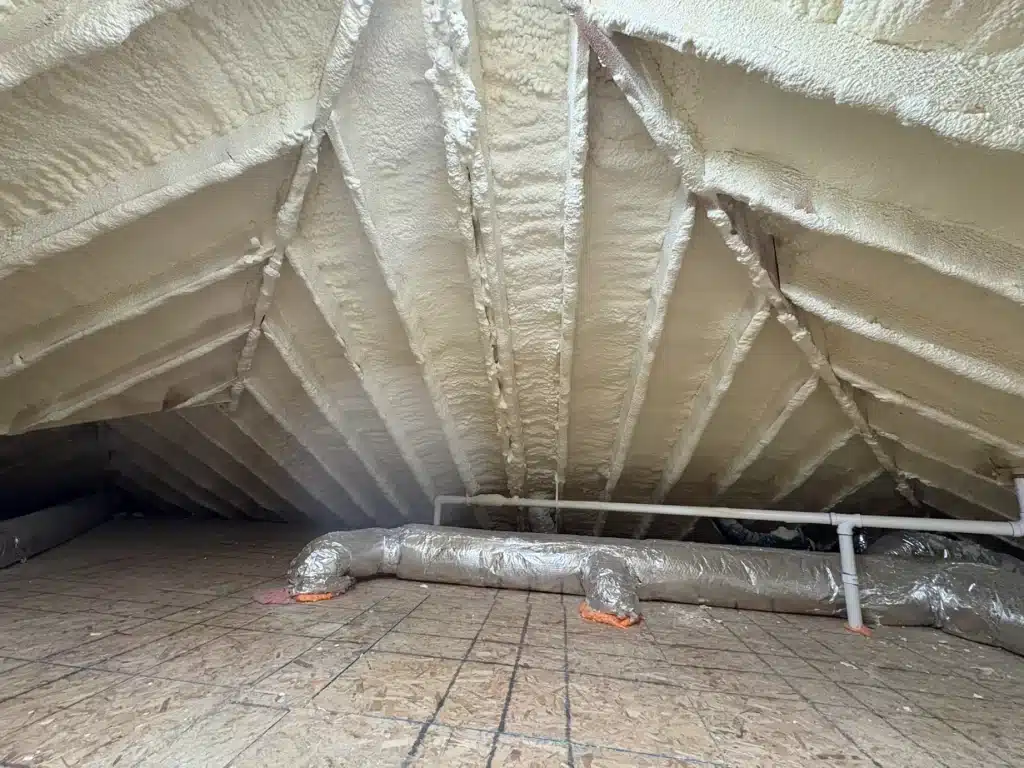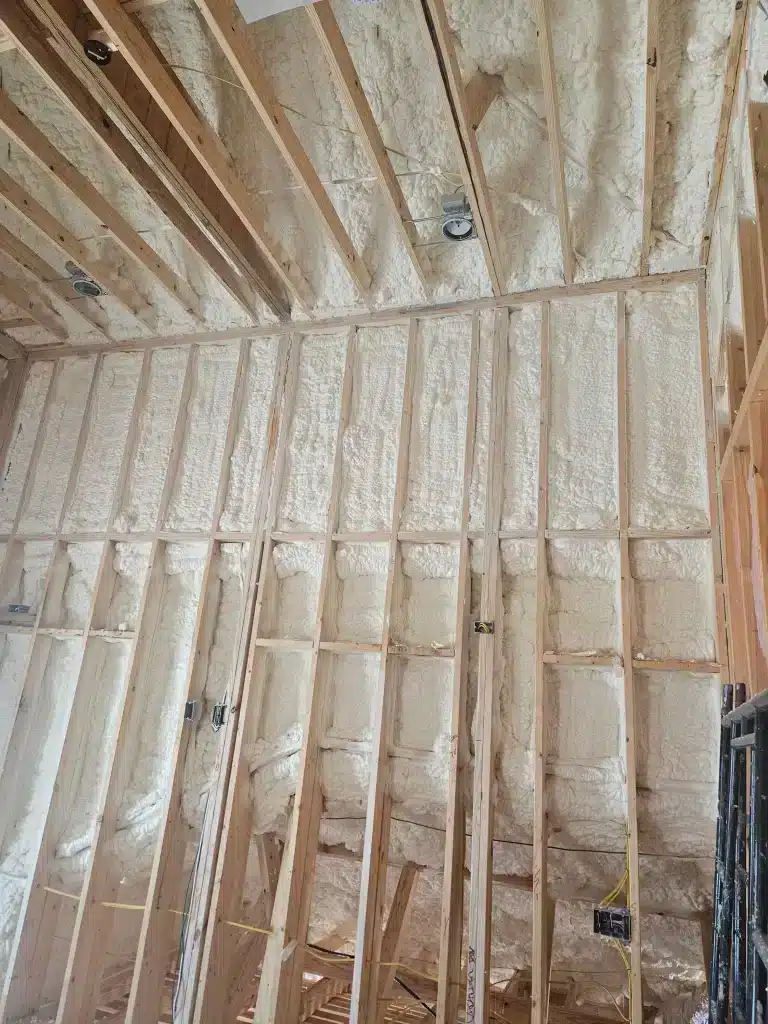

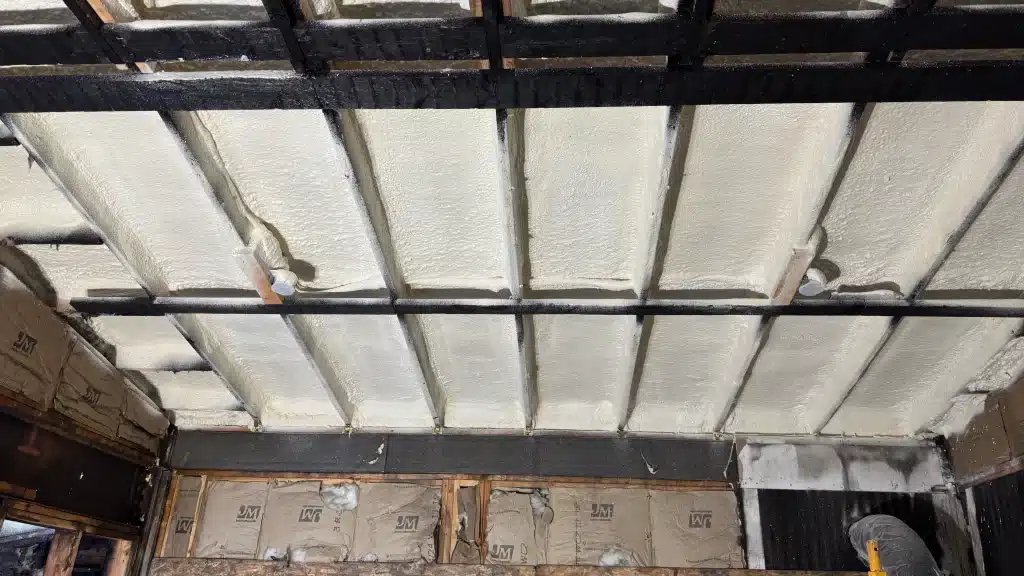
Closed-cell spray foam insulation directly tackles the biggest comfort and durability problems Corcoran homeowners face, including extreme summer heat penetrating walls and attics, high air conditioning costs, indoor humidity from agricultural moisture, and pest infiltration through gaps in the building envelope. With an R-value of 6.0 to 7.0 per inch, a built-in moisture barrier, and an airtight seal that eliminates leaks, closed-cell foam addresses multiple issues simultaneously in a single application.
TLDR / Key Takeaways
- Corcoran sits in California Climate Zone 13, a hot-dry valley region where summer temperatures regularly exceed 100°F, making high-performance insulation a necessity rather than a luxury.
- Closed-cell spray foam delivers R-6.0 to R-7.0 per inch, roughly double the thermal resistance of standard fiberglass batts at the same thickness.
- The material acts as a continuous air barrier and vapor retarder in one step, sealing gaps that conventional insulation leaves open.
- Homes in the Central Valley can reduce heating and cooling energy use by 30% to 50% with properly installed spray foam, according to industry performance data.
- Closed-cell foam adds structural rigidity to walls and framing, which benefits older Corcoran homes built before modern seismic and structural codes.
- The California Energy Code recognizes spray foam’s superior performance and sets specific R-value thresholds (R-5.8 per inch for closed cell) for compliance.
- Agricultural dust and allergens common in the Corcoran area are significantly reduced when the building envelope is properly sealed with closed-cell foam.
Why Corcoran Homes Face Unique Comfort and Efficiency Challenges
Corcoran, located in Kings County in the heart of the San Joaquin Valley, experiences some of the most demanding climate conditions in California. Summers are long, hot, and dry, with average high temperatures from June through September frequently climbing above 100°F. Winters are mild but damp, and the surrounding agricultural land introduces elevated levels of moisture, dust, and allergens that find their way into homes through even the smallest gaps and cracks.
Most homes in Corcoran were built decades ago with insulation standards far below what current building science recommends. According to California Energy Commission data, the state’s current energy code requires specific R-values for attics, walls, and floors that older homes simply do not meet. Many existing homes rely on blown-in fiberglass or cellulose that has settled over time, losing effectiveness and leaving air pathways open.
The California Climate Zone Map classifies the Central Valley corridor, where Corcoran sits, as Climate Zone 13, characterized by hot, dry summers and moderate winters with occasional fog and moisture. Homes in this zone need insulation that does more than slow down heat transfer. They need a material that blocks air movement, resists moisture accumulation, and maintains its performance over decades without sagging, settling, or degrading.
How Closed Cell Spray Foam Works
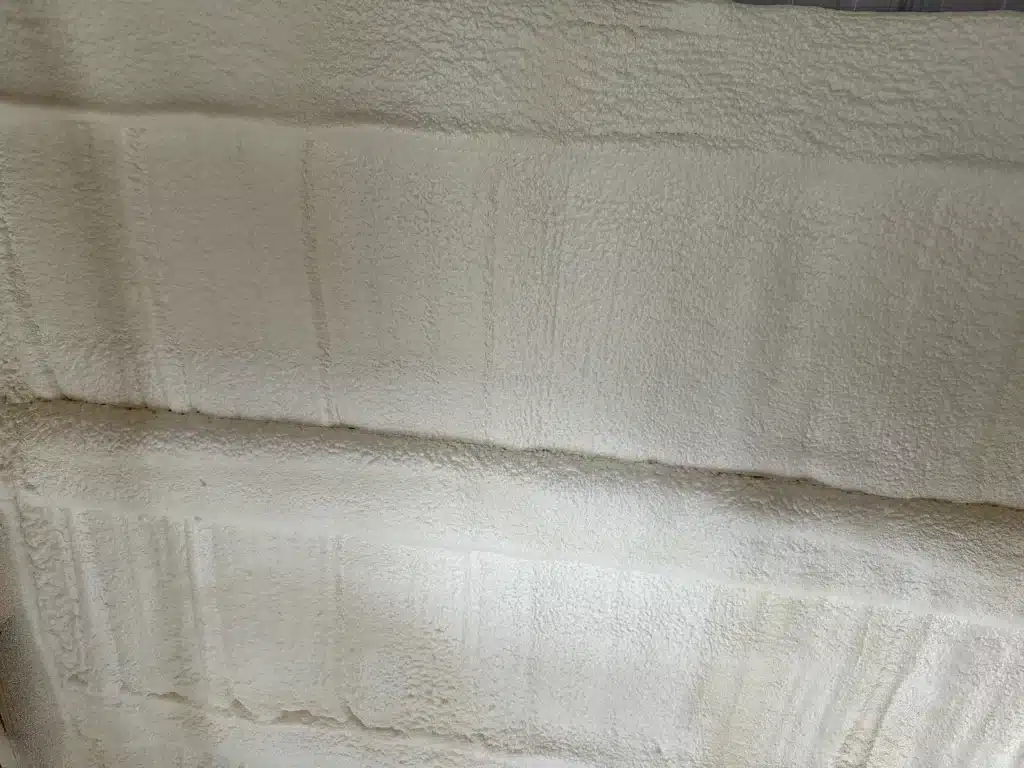
Closed-cell spray foam is a two-component polyurethane system that expands to roughly 30 to 40 times its liquid volume when applied. As it cures, it forms a dense, rigid material with a closed cellular structure. Each tiny cell is filled with an insulating gas rather than air, which is what gives the material its high R-value per inch. According to Wikipedia, spray foam insulation is widely recognized as one of the most effective methods for achieving both thermal resistance and an airtight building envelope in a single application.
Building Energy Vermont identifies seven primary benefits of closed-cell spray foam insulation: it acts as a powerful insulator, delivers significant energy savings, creates an airtight seal, functions as a moisture barrier, deters mold growth, adds structural strength, and provides long-lasting durability. These benefits apply directly to the problems Corcoran homeowners encounter.
The foam bonds directly to wood framing, concrete, metal, and most other building materials. This adhesion means it does not rely on friction fit or compression like fiberglass batts, so there are no gaps around studs, pipes, or electrical boxes. Every cavity gets a custom-fit layer of insulation that also seals the air boundary.
Performance Comparison: Closed Cell Foam vs. Common Alternatives
To understand why closed-cell foam stands out for Corcoran homes, it helps to compare it against the insulation types most commonly found in the area.
| Insulation Type | R-Value per Inch | Air Barrier | Moisture Barrier | Lifespan | Best Application |
|---|---|---|---|---|---|
| Closed Cell Spray Foam | 6.0 – 7.0 | Yes | Yes (Class II vapor retarder) | 80+ years | Walls, crawl spaces, rim joists, and attics |
| Open Cell Spray Foam | 3.5 – 3.7 | Yes | No | 50+ years | Interior walls, soundproofing |
| Fiberglass Batts | 2.9 – 3.8 | No | No | 15-20 years | Standard wall cavities (new construction) |
| Blown-In Cellulose | 3.1 – 3.8 | Partial | No | 20-30 years | Attics, existing wall cavities |
| Rigid Foam Board | 3.8 – 6.5 | No (joints leak) | Varies by type | 50+ years | Basement walls, continuous exterior insulation |
Truitt & White, a Bay Area building materials supplier, notes that closed-cell spray foam delivers the highest R-value per inch and an unbeatable air seal among common insulation materials. For Corcoran homeowners dealing with hot attic spaces and leaky wall cavities, this combination makes a measurable difference in indoor comfort.
Advance Insulation further explains that 2-pound closed-cell spray foam specifically helps reduce heating and cooling costs through its dual ability to resist heat transfer and prevent air leakage simultaneously.
Specific Home Issues Closed Cell Foam Solves in Corcoran
1. Sky-High Summer Cooling Bills
Air conditioning accounts for the largest share of energy consumption in Corcoran homes during the summer months. When a home lacks a proper air barrier, cooled indoor air escapes through gaps around windows, doors, plumbing penetrations, and electrical outlets, while hot outdoor air is pulled in to replace it. This is called stack effect and infiltration, and it forces HVAC systems to run far more than necessary.
The U.S. Department of Energy confirms that proper air sealing combined with insulation is one of the most cost-effective ways to reduce energy waste in residential buildings, noting that air leaks can account for 25% to 40% of the energy used for heating and cooling. Insulation Labs reports that spray foam insulation can deliver energy savings of 30% to 50% by eliminating these air leaks and reducing the thermal load on HVAC equipment. For a Corcoran homeowner spending $300 per month on cooling during peak summer, that translates to potential savings of $90 to $150 per month.
2. Moisture and Mold in Crawl Spaces and Walls
Corcoran’s proximity to agricultural irrigation and its position on the valley floor mean humidity levels can spike, especially during early morning hours and in the cooler months. Homes with vented crawl spaces are particularly vulnerable, as warm, moist outside air enters the cool crawl space environment and condenses on surfaces.
The U.S. Environmental Protection Agency (EPA) identifies excess moisture as one of the leading causes of indoor air quality problems, contributing to mold growth, structural damage, and respiratory health concerns. Closed-cell spray foam applied to crawl space walls and the underside of the floor framing creates a moisture-resistant barrier that prevents condensation from forming. The foam’s closed-cell structure does not absorb water, so even in the event of a minor plumbing leak or flooding, the insulation maintains its structural integrity and R-value.
3. Allergens, Dust, and Pest Intrusion
Agricultural dust, pollen, and field debris are constant concerns for Corcoran residents. When a home has air leaks, these particulates are drawn inside through the same gaps that allow air infiltration. Rodents and insects also exploit these openings to enter wall cavities and attic spaces.
Research from the Harvard T.H. Chan School of Public Health has shown that airtight building envelopes with controlled mechanical ventilation significantly reduce the infiltration of outdoor allergens, pesticides, and particulate matter, leading to measurable improvements in respiratory health outcomes for occupants. Closed-cell foam seals the building envelope so tightly that it eliminates the entry points pests use. Mice, rats, and insects cannot chew through cured spray foam, and the continuous seal prevents dust-laden air from infiltrating through rim joists, wall penetrations, and attic bypasses.
4. Uneven Temperatures Between Rooms
Many Corcoran homeowners notice that some rooms stay uncomfortably warm while others feel cold, even when the thermostat is set to a single temperature. This is almost always caused by inconsistent insulation levels and air leakage in different parts of the building envelope. Rooms over garages, additions, and spaces with vaulted ceilings are common problem areas.
Closed-cell foam installed in these specific problem zones creates consistent thermal resistance across the entire envelope. Because it fills every gap and cavity, there are no weak points where heat can transfer preferentially.
5. Structural Weaknesses in Older Homes
Corcoran has a significant stock of older homes, many built between the 1940s and 1970s. These homes often have limited wall bracing and structural connections that do not meet modern standards. The National Institute of Standards and Technology (NIST) has documented how polyurethane foam insulation enhances the structural performance of wall assemblies by increasing racking resistance and shear capacity. Closed-cell spray foam, with its rigid cured density, adds shear strength to wall assemblies when applied to stud cavities. The foam adheres to both the interior sheathing and the exterior cladding, effectively tying the assembly together and reducing racking under wind or seismic loads.
Real-World Scenarios: Corcoran Homes Transformed
| Scenario | Home Type | Problem | Solution | Outcome |
|---|---|---|---|---|
| Corcoran ranch home built in 1965 | 1,400 sq ft single-story | Summer cooling bills over $350/month, hot upstairs bedrooms | Closed cell foam in attic rafters (R-38) and exterior walls (R-21) | Cooling costs dropped to roughly $180/month, and bedrooms stayed within 4°F of the thermostat setting |
| Farmworker family duplex near farmland | 2,800 sq ft two-unit | Persistent dust allergies, musty smell from the crawl space | Closed-cell foam sealed crawl space walls and floor, rim joists encapsulated | Dust infiltration reduced noticeably, crawl space humidity dropped below 50%, and musty odor was eliminated |
| Newly purchased home on the west side of Corcoran | 1,800 sq ft 1980s build | Drafty rooms, winter heating inconsistent, visible gaps around framing | Closed cell foam in wall cavities and band joists, open cell in interior partitions for sound control | Year-round energy costs reduced by an estimated 35%, drafts eliminated, noise between rooms decreased |
| Corcoran home with addition | 2,200 sq ft including unpermitted addition | Addition rooms 10-15°F hotter in summer, HVAC struggling to keep up | Closed cell foam sprayed into addition walls, vaulted ceiling, and knee walls | Temperature differential between original home and addition dropped to under 2°F, HVAC no longer ran continuously |
Actionable Steps for Corcoran Homeowners Considering Closed Cell Foam
1. Schedule a Home Energy Assessment
Before making any insulation decisions, hire a qualified energy auditor to perform a blower door test and thermal scan. This identifies exactly where air leaks exist and where insulation is missing or damaged. Many utility companies, including PG&E, offer rebates or low-cost assessments for Central Valley residents.
2. Prioritize the Building Envelope
Focus on the areas that have the biggest impact first: the attic, rim joists, and crawl spaces. These three locations account for the majority of air leakage in most homes. Sealing them with closed-cell foam delivers the fastest return on investment.
3. Match Foam Type to the Application
Not every area needs closed-cell foam. Use closed-cell in crawl spaces, basements, rim joists, and exterior walls where moisture resistance and high R-value per inch matter. Open-cell foam may be more cost-effective for interior soundproofing and large, open attic cavities where space is not limited.
4. Verify Installer Credentials and Insurance
Spray foam installation requires specialized equipment, training, and safety protocols. Confirm that your installer carries liability insurance, workers’ compensation coverage, and manufacturer certifications. Request references from other Central Valley projects.
5. Plan for Ventilation Upgrades
Tightening the building envelope with closed-cell foam reduces natural air exchange. In many cases, this is beneficial, but it may require adding mechanical ventilation to maintain healthy indoor air quality. ASHRAE, the global authority on building system standards, recommends that when homes are tightened beyond certain air leakage thresholds, balanced mechanical ventilation should be introduced to ensure adequate fresh air delivery and prevent indoor pollutant buildup. Discuss whether your home needs a balanced ventilation system or upgraded exhaust fans with your insulation contractor.
Key Factors That Affect Closed Cell Foam Performance in Corcoran
- Installed Thickness and R-Value Compliance: The California Energy Code defines non-standard R-values as anything above R-5.8 per inch for closed-cell foam. Installers must apply enough thickness to meet the code-required total R-value for each building assembly. In Climate Zone 13, attic assemblies typically require R-38 or higher.
- Substrate Preparation: The surfaces being sprayed must be clean, dry, and free of dust and oil. Poor substrate conditions can prevent the foam from adhering properly, which reduces both its insulating and structural benefits.
- Temperature During Installation: Spray foam cures best when ambient and substrate temperatures are between 60°F and 90°F. Corcoran’s summer heat can accelerate curing and potentially affect expansion consistency, so experienced installers may adjust chemical ratios or schedule work during cooler morning hours.
- Cavity Depth and Framing Spacing: The available cavity depth determines the maximum R-value achievable in a single pass. Standard 2×4 walls (3.5 inches) max out around R-24 with closed-cell foam, while 2×6 walls (5.5 inches) can reach R-38.
- Aging and Thermal Drift: Over time, the blowing agent inside closed-cell foam cells can slowly diffuse out and be replaced by air, which slightly reduces the R-value. Quality manufacturers account for this by listing both initial and aged R-values. Ask your installer for the long-term aged R-value, not just the initial number.
- Building Envelope Completeness: Closed-cell foam delivers its best results when applied as a continuous system. Gaps or unsealed transitions between insulated sections create thermal bridges that undermine the overall performance.
Ready to Fix Your Home’s Biggest Comfort Problems
If you are a Corcoran homeowner dealing with high energy bills, uneven temperatures, musty crawl spaces, or persistent dust and allergens, closed-cell spray foam offers a single solution that addresses all of these issues at once. At Supreme Spray Foam Fresno, we have extensive experience insulating homes throughout the Central Valley, and we understand the specific demands that Corcoran’s climate places on your building envelope. Our team uses premium materials and precise installation techniques to deliver lasting results that improve comfort, reduce energy costs, and protect your home for decades.
Call us at (559) 545-0800 or email [email protected] to get started. We will evaluate your home, identify the problem areas, and recommend the right insulation strategy for your budget and goals.
Sources
- Wikipedia – Spray Foam Insulation – Comprehensive overview of spray foam insulation types, properties, and applications in residential construction.
- Wikipedia – R-value (Insulation) – Explanation of thermal resistance measurement used to rate insulation materials and their effectiveness.
- U.S. Department of Energy – Energy Saver: Insulation – Federal guidance on insulation selection, air sealing benefits, and energy savings potential for homeowners.
- U.S. Environmental Protection Agency – Indoor Air Quality (IAQ) – EPA resources on moisture control, mold prevention, and maintaining healthy indoor environments.
- Harvard T.H. Chan School of Public Health – Healthy Homes – Research on how building envelope tightness and ventilation affect allergen infiltration and occupant respiratory health.
- ASHRAE – Technical Resources – Industry standards and guidance on mechanical ventilation requirements for tightly sealed residential buildings.
FAQs
How does closed-cell spray foam compare in cost to fiberglass insulation?
Closed-cell spray foam has a higher upfront cost than fiberglass, typically two to three times more per square foot. However, the energy savings, air sealing benefits, moisture resistance, and longer lifespan make the total cost of ownership lower over time. For Corcoran homeowners dealing with extreme heat, the payback period is often between five and seven years.
Can closed-cell foam be installed in an existing home with finished walls?
Yes, closed-cell foam can be installed in existing homes through several methods. For walls with accessible cavities, small holes can be drilled through the exterior or interior and foam injected behind the finished surface. Attics, crawl spaces, and rim joists are fully accessible in most homes and do not require any demolition.
Does closed-cell spray foam require any special maintenance?
No routine maintenance is needed for closed-cell spray foam once it is properly installed and cured. The material does not settle, sag, or degrade over time. The only situation that may require attention is if the foam is physically damaged by construction work or plumbing repairs, in which case a professional can patch the affected area.
Is closed-cell foam safe for homes with children and pets?
Once fully cured, which typically takes 24 to 48 hours, closed-cell spray foam is inert and non-toxic. During installation, the home should be vacated and the area ventilated per the manufacturer’s guidelines. Reputable installers use appropriate protective equipment and follow all safety protocols to ensure occupant health.
How long does a closed-cell spray foam installation take?
Most residential projects in Corcoran are completed in one to two days, depending on the size of the home and the areas being insulated. A typical 1,500 square foot home with attic and crawl space work can often be finished in a single day. Wall insulation in existing homes may take an additional day. Occupants can usually return the evening after installation is complete.